

Risk management can feel overwhelming when you’re staring at a spreadsheet full of threats and trying to figure out which ones deserve your attention first. Some risks scream for immediate action. Others can wait. The challenge is knowing which is which.
That’s where two powerful approaches come in: quantitative and qualitative risk analysis. Both help you evaluate threats, but they take completely different paths to get there. One relies on numbers and probability. The other leans on judgment and experience. Understanding when to use each method can transform how you protect your projects, your team, and your organization.
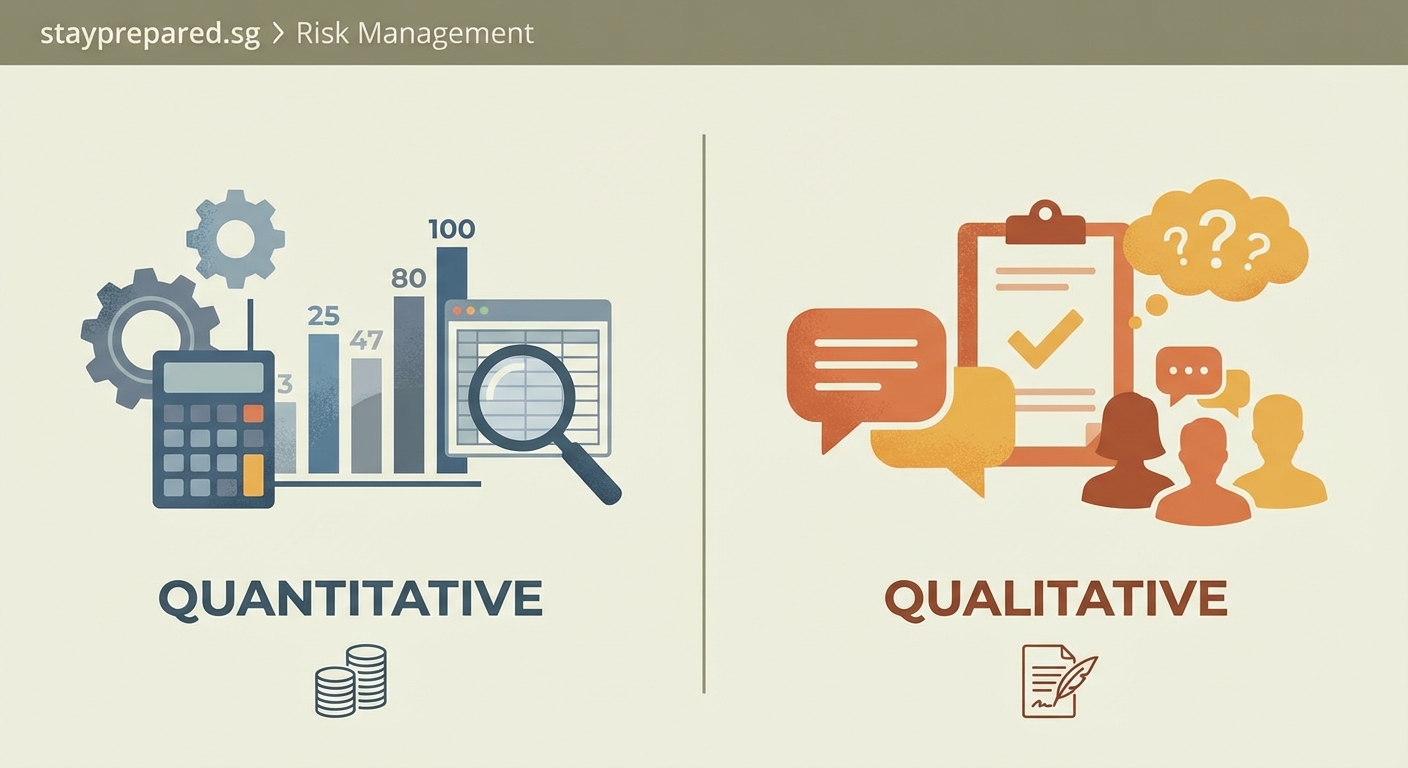
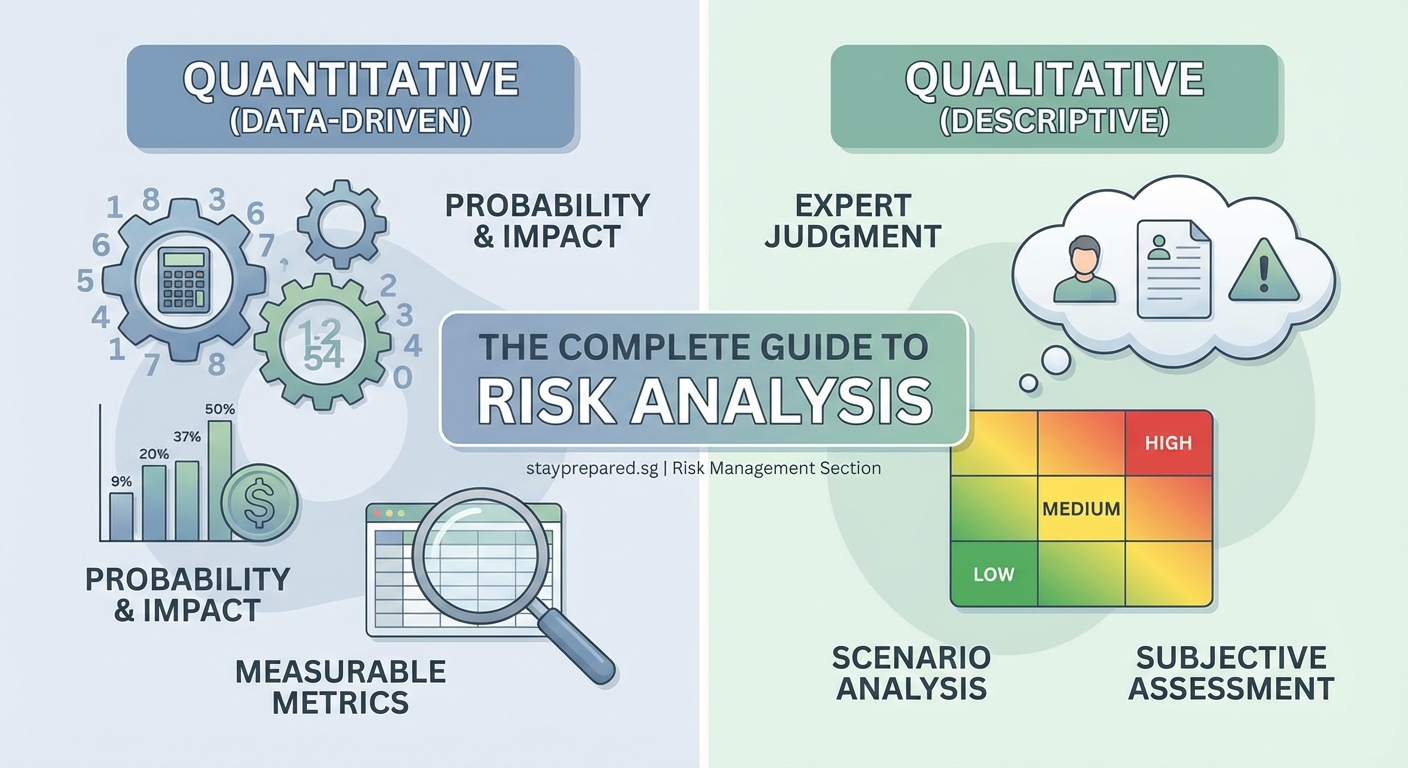
Quantitative risk analysis uses numerical data, statistical models, and probability calculations to measure risk impact in concrete terms like dollars or hours. Qualitative risk analysis relies on expert judgment, descriptive scales, and subjective assessment to prioritize risks based on likelihood and severity. Most effective risk management strategies combine both approaches, using qualitative methods for initial screening and quantitative analysis for high-priority threats requiring detailed financial planning.
What makes qualitative risk analysis different
Qualitative risk analysis starts with conversation and observation. You gather your team, review potential threats, and assess each one based on experience and expertise. No complex formulas required.
This approach uses descriptive categories instead of precise numbers. You might rate a risk as “high,” “medium,” or “low.” Or use a scale from one to five. The goal is to create a priority list fast, so you know where to focus your energy.
Think of it like triaging patients in an emergency room. The doctor doesn’t run every possible test on everyone who walks through the door. They make rapid assessments based on visible symptoms, vital signs, and professional judgment. Life-threatening cases get immediate attention. Minor injuries wait.
Qualitative analysis works the same way. You’re sorting threats into categories that make sense for your situation. The process is flexible, fast, and doesn’t require extensive data collection.
Here’s what makes this method valuable:
- You can start immediately, even with limited information
- Team discussions surface insights that data alone might miss
- The process adapts easily to different types of risks
- Results are easy to communicate to non-technical stakeholders
- You avoid analysis paralysis when time is tight
The main tool is a risk matrix. You plot each threat on a grid based on two factors: how likely it is to happen and how much damage it would cause. Risks in the upper right corner (high likelihood, high impact) become your top priorities.
When numbers tell the story better
Quantitative risk analysis takes a different route. Instead of descriptive categories, you work with actual numbers. Probabilities. Dollar amounts. Time estimates. Statistical distributions.
This method answers questions that qualitative analysis can’t touch. What’s the expected monetary value of this risk? How much contingency budget should we set aside? What’s the probability of finishing this project on time given all the identified threats?
You might use Monte Carlo simulations, decision tree analysis, or sensitivity testing. These techniques run thousands of scenarios to show you the range of possible outcomes. The output isn’t a simple “high risk” label. It’s a precise estimate with confidence intervals.
Consider a construction project facing weather delays. A qualitative assessment might rate this as a “medium probability, high impact” risk. A quantitative analysis would calculate the exact cost impact based on historical weather data, daily labor rates, and contract penalties. You’d know that there’s a 35% chance of a two-week delay costing $180,000, or a 10% chance of a four-week delay costing $420,000.
That level of detail changes how you plan. You can justify specific budget reserves. You can make informed decisions about risk mitigation investments. You can show executives exactly what’s at stake in terms they understand.
Breaking down the core differences
The contrast between these two approaches becomes clearer when you compare them side by side.
| Aspect | Qualitative Analysis | Quantitative Analysis |
|---|---|---|
| Primary input | Expert judgment and experience | Numerical data and statistical models |
| Output format | Descriptive categories and rankings | Precise figures and probability distributions |
| Time required | Hours to days | Days to weeks |
| Data needs | Minimal, can work with limited info | Extensive, requires reliable historical data |
| Cost | Low, mainly staff time | Higher, may need specialized software and expertise |
| Best for | Initial screening, broad overview | Detailed planning, financial justification |
| Uncertainty handling | Implicit in category ranges | Explicit through probability calculations |
| Stakeholder communication | Intuitive, easy to grasp | Requires explanation, can seem abstract |
Neither approach is universally better. They serve different purposes at different stages of risk management.
How to run a qualitative assessment
Starting with qualitative analysis makes sense for most projects. You get visibility into your risk landscape without a massive upfront investment.
Here’s a practical process that works:
- Gather your core team and relevant subject matter experts for a structured workshop.
- Review the project scope, objectives, and constraints to establish context.
- Brainstorm potential risks across all categories: technical, operational, financial, external, and organizational.
- For each identified risk, discuss and rate the probability of occurrence using your chosen scale.
- Assess the potential impact on project objectives if the risk materializes.
- Plot each risk on your matrix and identify which ones fall into your “high priority” zone.
- Document assumptions, rationale, and any disagreements for future reference.
- Schedule regular reviews to update assessments as the project progresses.
The conversation during this process often matters more than the final ratings. Team members share concerns they might not raise otherwise. Patterns emerge. You spot connections between risks that seemed unrelated.
One project manager I know runs these sessions with sticky notes on a wall-sized matrix. Each risk gets its own note. The team physically moves them around as they debate probability and impact. The tactile process keeps people engaged and makes the abstract feel concrete.
The best risk analysis doesn’t just identify threats. It creates shared understanding across your team about what matters most and why you’re taking specific actions to protect the project.
Building a quantitative model
When you need precision, quantitative methods deliver. But they require more setup and expertise.
Start by identifying which risks deserve this level of analysis. You can’t (and shouldn’t) quantify everything. Focus on threats that could significantly impact project success and where numerical precision adds real value to decision making.
For each selected risk, you need three key inputs:
- The range of possible impacts expressed in measurable units (dollars, days, resources)
- The probability distribution that best represents likelihood (normal, triangular, uniform, or custom)
- The relationships and dependencies between different risks
Software tools like @RISK or Crystal Ball can run simulations once you’ve defined your model. They generate thousands of iterations, each one playing out a different combination of risk events. The output shows you the probability of different outcomes.
Say you’re managing a software development project with three major risks: requirements changes, key staff turnover, and third-party integration delays. Each risk has its own probability and impact range. But they’re not independent. Staff turnover makes integration delays more likely because you lose institutional knowledge.
A quantitative model captures these relationships. After running 10,000 simulations, you might learn there’s a 70% chance of finishing within budget, a 20% chance of overrunning by 10-15%, and a 10% chance of exceeding budget by more than 25%. That precision helps you set appropriate reserves and gives executives realistic expectations.
Combining both approaches for better results
The most effective risk management doesn’t pick one method over the other. It uses both strategically.
Think of qualitative analysis as your first pass filter. You cast a wide net, identify all potential threats, and sort them into priority tiers. This happens early and often throughout your project.
Then you apply quantitative analysis selectively to your highest priority risks. The ones that could derail the project. The ones that need detailed financial planning. The ones where stakeholders demand precise justification for mitigation spending.
This layered approach gives you the best of both worlds. You maintain broad visibility without drowning in data collection. You get precision where it matters without wasting time on minor threats.
Here’s how this plays out in practice:
- Run qualitative assessments monthly or at major project milestones
- Use quantitative models for annual budget planning and major investment decisions
- Update quantitative models quarterly or when significant new information emerges
- Communicate qualitative results broadly to keep everyone aware
- Reserve quantitative details for leadership reviews and formal reporting
The transition point between methods isn’t always obvious. A good rule of thumb: if a risk could consume more than 5% of your project budget or timeline, it probably deserves quantitative analysis.
Common mistakes that undermine your analysis
Even experienced professionals fall into traps that weaken their risk assessments.
Confirmation bias hits qualitative analysis hard. Teams unconsciously downplay risks that threaten their preferred approach or highlight threats that support their existing concerns. Combat this by explicitly seeking out dissenting opinions and rotating who leads assessment sessions.
Overconfidence in data quality plagues quantitative models. Your simulation is only as good as your inputs. If you’re using outdated historical data or making assumptions about probability distributions without validation, your precise-looking numbers are misleading. Always document data sources and confidence levels.
Another frequent error: treating qualitative ratings as if they were quantitative data. You can’t meaningfully average “high” and “low” to get “medium.” You can’t multiply a “3” likelihood rating by a “4” impact rating and claim the result means anything specific. Qualitative scales are ordinal, not interval. They show relative position, not precise measurement.
Analysis paralysis strikes when teams try to quantify everything. Some risks genuinely don’t have enough data for meaningful quantitative analysis. Forcing numbers onto them creates false precision and wastes time. Know when to accept qualitative judgment as the best available answer.
Finally, one-time assessments fail regardless of method. Risk landscapes shift constantly. New threats emerge. Probabilities change. Impacts evolve. Both qualitative and quantitative analyses need regular updates to stay relevant.
Choosing the right method for your situation
Your choice between methods depends on several factors beyond just preference.
Consider your available data first. Quantitative analysis needs reliable historical information about similar risks. If you’re working on something truly novel or in a rapidly changing environment, you might not have enough data to build trustworthy models. Qualitative methods handle uncertainty and limited information better.
Time pressure matters too. A qualitative assessment can happen in a single afternoon workshop. Building and validating a quantitative model might take weeks. If you need to make decisions fast, start qualitative and add quantitative detail later for critical risks.
Stakeholder expectations shape your approach. Some executives trust numbers and want to see probability curves and expected monetary values. Others prefer straightforward priority rankings they can grasp immediately. Tailor your method to your audience.
Regulatory requirements sometimes force the issue. Certain industries mandate quantitative risk analysis for specific decisions. Financial institutions, pharmaceutical companies, and major infrastructure projects often face these requirements. Check your compliance obligations before choosing.
Team capability is practical consideration. Quantitative analysis requires statistical expertise and specialized software. If you don’t have those resources in-house and can’t hire consultants, qualitative methods might be your only realistic option.
Making your analysis actionable
Analysis without action is just expensive documentation. The real value comes from what you do with your results.
For qualitative assessments, translate your priority matrix into specific action items. High-priority risks need mitigation plans with assigned owners and deadlines. Medium risks need monitoring triggers that tell you when they’re escalating. Low risks get documented but don’t consume active management attention.
Create a risk register that lives and breathes. Update it regularly. Review it in team meetings. Make it a living document that guides daily decisions, not a compliance artifact gathering dust.
Quantitative analysis should directly inform your contingency planning. If your model shows a 20% chance of cost overruns exceeding $200,000, your contingency reserve should reflect that reality. Use the probability distributions to set reserves at appropriate confidence levels for your organization’s risk tolerance.
Share results in formats that drive understanding. For qualitative work, visual heat maps work better than tables of text. For quantitative models, show probability curves and tornado diagrams that highlight which risks matter most. Avoid dumping raw simulation output on stakeholders.
Build feedback loops that improve your analysis over time. Track which risks actually materialized and compare them to your predictions. This calibration makes future assessments more accurate and builds confidence in your process.
Applying this to your next project
You now understand the fundamental differences between quantitative and qualitative risk analysis. You know when each method shines and how they complement each other.
Start your next project with a qualitative assessment to map the risk landscape. Get your team together, identify threats, rate them, and create your priority list. This foundation costs little but provides immediate value.
Then look at your top three to five risks. Ask yourself: would numerical precision help us make better decisions about these threats? Would it justify additional mitigation spending to leadership? If yes, invest in quantitative modeling for those specific risks.
Remember that both methods are tools, not religions. Use what works for your situation. Adapt the processes to fit your team, your timeline, and your organizational culture. The goal isn’t perfect analysis. It’s better decisions that protect what matters most to your project and your stakeholders.