
“`markdown
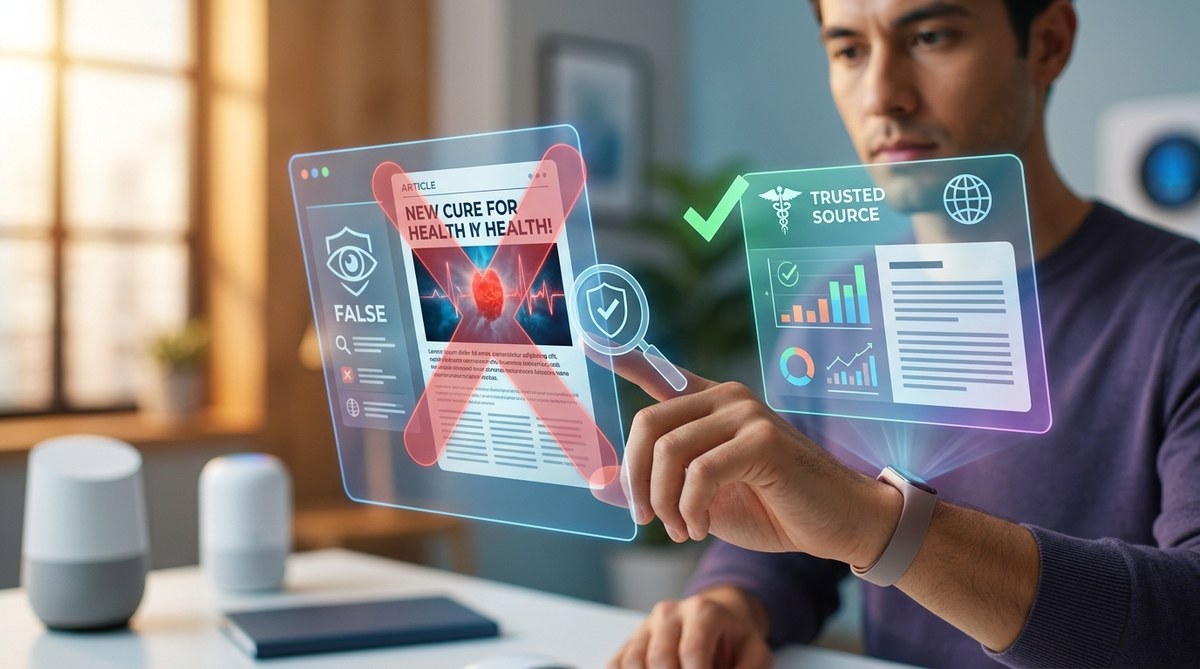
You scroll through your feed and see a headline: “New Study Shows This One Vitamin Cures Arthritis Overnight.” It sounds too good to be true. Your aunt shares it in the family group chat. Your neighbor posts it on Facebook. Before you know it, the claim has spread like a cold through a daycare. In 2026, fake health news is more convincing than ever. AI tools can generate realistic images, fake doctor credentials, and entire articles that look like they came from WebMD or the Mayo Clinic. For health-conscious individuals, caregivers, and older adults, the stakes are high. A bad health tip can lead to missed diagnoses, harmful treatments, or wasted money on useless supplements. Learning how to spot fake health news is a survival skill for the digital age.
Fake health news in 2026 uses AI-generated content, fake expert endorsements, and emotional manipulation to trick readers. You can protect yourself by checking the source, looking for peer-reviewed research, cross-referencing with trusted health organizations, watching for sensational language, and using fact-checking tools. A few minutes of verification can save you from dangerous misinformation.
Why Fake Health News Is Such a Big Problem in 2026
Fake health news has been around since snake oil salesmen pitched tonics from the back of a wagon. But today, the tools are far more sophisticated. Generative AI can produce a convincing video of a doctor from a major hospital endorsing a bogus diabetes cure. Deepfake voices can mimic a celebrity saying they reversed aging with a single supplement. Social media algorithms amplify content that gets the most engagement, and shocking health claims drive clicks.
Older adults and caregivers are especially vulnerable. A 2025 Pew Research study found that nearly 40% of Americans over 65 reported sharing health news on social media that later turned out to be false. Caregivers, already stressed and seeking solutions, are prime targets for miracle cures for chronic conditions. The emotional weight of a loved one’s illness can override our usual skepticism.
This is not just about bad advice. It is about health security. When you follow fake health news, you risk delaying real treatment, taking dangerous unregulated supplements, or falling for a scam that steals your personal data. That is why knowing how to spot fake health news is as important as knowing the difference between a cold and the flu.
The Red Flag Checklist: Warning Signs to Scan For
Before you share or act on any health information, run through this mental checklist. If you see any of these warning signs, stop and investigate further.
- Sensational or absolute language. Phrases like “cure all,” “breakthrough,” “doctors hate this,” or “you won’t believe” are designed to trigger an emotional reaction, not inform.
- No named author or vague credentials. If the article says “by a health expert” but does not give a name or show a real medical license, that is a red flag.
- Missing or one-sided sources. Legitimate health news links to peer-reviewed studies, government health agencies, or major medical journals. Fake news often cites “a recent study” with no link or a link to a site that sounds official but is not.
- Before-and-after photos that look too perfect. AI can generate fake images. Look for unnatural lighting, distorted fingers, or backgrounds that seem off.
- Claims that contradict mainstream guidelines. If you see a headline saying “the CDC is wrong about flu vaccines,” be skeptical. Established health bodies have processes that are far from perfect, but they rely on large-scale evidence.
- Requests for payment or personal information. A “free health guide” that asks for your credit card number is a scam, plain and simple.
- Unsubstantiated testimonials. One person’s story is not evidence. Anecdotes can be made up, especially when they are anonymous.
A Practical 5-Step Process to Verify Any Health Claim
When a health story catches your attention, do not just scroll past or share it. Use this step-by-step method to know how to spot fake health news for yourself.
-
Pause and identify the source. Look at the website name. Is it a known medical institution, a government domain (.gov), or a reputable health publisher like the Mayo Clinic, Cleveland Clinic, or WebMD? If the site is “.com” and you have never heard of it, check the “About Us” page. Fake health news sites often claim to be “a leading research institute” but provide no actual contact details.
-
Find the original research. If the article mentions a study, search for the title or the lead author’s name. Use Google Scholar or PubMed to see if the study really exists. Many fake news pieces invent citations. For example, a claim about “a 2026 Harvard study proving celery juice cures cancer” should be traceable. If you cannot find it, assume it is false.
-
Cross-reference with trusted health organizations. The CDC, FDA, WHO, and the National Institutes of Health (NIH) are reliable starting points. If a claim is genuinely important, you will see coverage from multiple credible sources. Use fact-checking sites like FactCheck.org, Snopes, or the AP Fact Check. They frequently debunk health hoaxes within hours.
-
Watch for emotional manipulation. Fake health news often preys on fear, hope, or anger. Headlines that say “This common food is killing you slowly” or “Pharma companies do not want you to know this” are trying to bypass your rational thinking. Step back. Ask yourself: does this feel designed to make me act without thinking?
-
Use a reverse image search. If the article includes a photo of a doctor, product, or patient, right-click the image and search with Google Images or TinEye. You might find the same image used for unrelated articles, revealing it is not a real doctor or product.
Techniques vs. Mistakes: A Quick Reference Table
| Fake News Technique | What It Looks Like | Common Mistake Readers Make |
|---|---|---|
| Fake doctor credentials | “Dr. Sarah Johnson, MD, PhD” with no verifiable license | Assuming the title alone proves expertise |
| Cherry-picked data | “70% of patients improved” without mentioning the small sample size | Thinking a percentage is always meaningful |
| False authority | A celebrity or influencer endorsing a treatment unrelated to their field | Trusting the fame, not the science |
| Misleading statistics | “Heart attacks dropped 50% after taking vitamin D” without adjusting for other factors | Believing correlation equals causation |
| Emotional testimonials | A tearful video of someone claiming a supplement cured their disease | Not verifying if the story is real or paid for |
What the Experts Say About Fake Health News
“The best defense against health misinformation is a healthy dose of skepticism combined with a few simple verification steps. If a claim sounds miraculous, it probably is. Always ask: Who is telling me this, and what do they stand to gain?” — Dr. Tara C. Smith, epidemiologist and professor at Kent State University
This advice applies to everyone, but especially to caregivers who are constantly searching for better options for their loved ones. When you are tired and worried, a quick fix seems like a lifeline. That is exactly when you need to slow down and check the facts.
Building Your Media Literacy Muscles
Spotting fake health news is a skill you can practice. Start small. The next time you see a health post online, run it through the checklist above. You will get better and faster over time.
A good habit is to bookmark a few trusted health websites and go to them directly instead of relying on social media feeds. The CDC’s website, the NIH MedlinePlus, and the FDA’s consumer updates are excellent starting points. For deeper dives, learn how to read a scientific abstract. You do not need a PhD to understand the basics: look at the sample size, whether the study was on humans or mice, and if it was published in a peer-reviewed journal.
Also, be aware of your own biases. If a headline confirms something you already believe, you are more likely to accept it uncritically. That is human nature. But it is also a gateway for fake health news to sneak in.
For more on related topics, check out our guide on how to recognize and prevent health scams in the digital age and the complete guide to identifying fake health products and medical scams online. These articles complement what you have learned here and will give you even more tools to stay safe.
Staying Safe in an Age of AI Health Hoaxes
Fake health news is not going away. In fact, as AI tools improve, the fakes will get harder to spot. But you have an advantage: you know what to look for. You can pause, check the source, find the study, and cross-reference with trusted organizations. You can resist the urge to share something that makes your heart race or your blood boil.
Remember, your health decisions should be based on evidence, not emotion. By learning how to spot fake health news, you protect yourself, your family, and your community. Next time a friend forwards you a miracle cure, you can help them see the truth. That is the kind of preparation that makes a real difference.
Stay curious, stay skeptical, and stay healthy.