

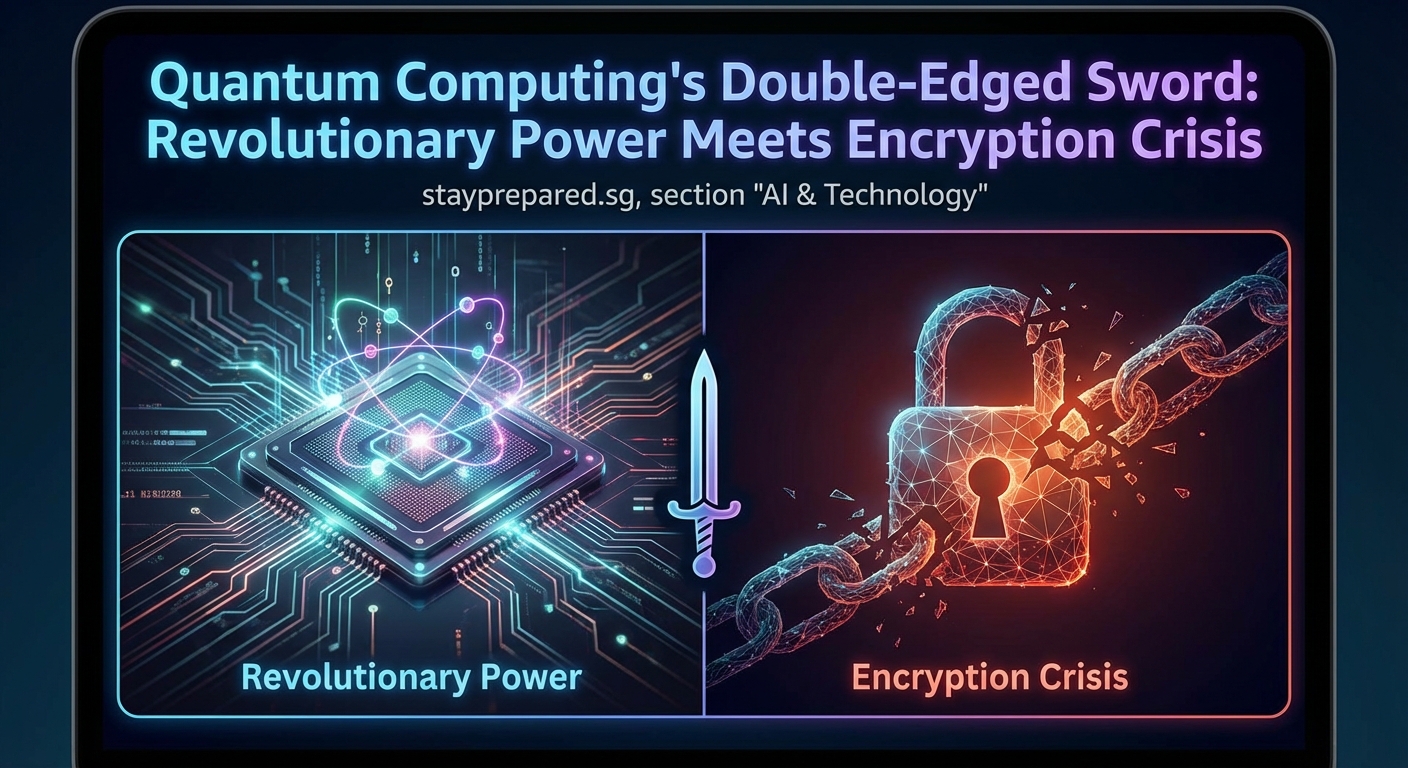
Quantum computers are no longer science fiction. They exist in labs right now, solving problems that would take traditional computers thousands of years. But this revolutionary power comes with a serious catch: the same capabilities that promise medical breakthroughs and climate solutions could also crack the encryption protecting your bank accounts, business secrets, and national security systems.
Quantum computing represents both massive opportunity and significant threat. While these machines can accelerate drug discovery and optimize logistics, they will eventually break current encryption methods. Organizations must understand both sides of this quantum computing double edged sword to prepare for post-quantum security while capitalizing on computational advantages that reshape entire industries.
Understanding quantum computing fundamentals
Traditional computers process information in bits: ones and zeros. Quantum computers use quantum bits, or qubits, which can exist in multiple states simultaneously through a phenomenon called superposition.
This difference sounds minor but creates exponential power increases.
A classical computer with three bits can represent one of eight possible values at any moment. A quantum computer with three qubits can represent all eight values at once. Scale that to 300 qubits, and you’re processing more combinations than there are atoms in the universe.
Entanglement adds another layer. When qubits become entangled, measuring one instantly affects the others, regardless of distance. This property allows quantum computers to solve certain problems with unprecedented efficiency.
But qubits are fragile. They lose their quantum properties through a process called decoherence when exposed to heat, electromagnetic fields, or vibrations. Most quantum computers operate near absolute zero to maintain stability.
The revolutionary applications reshaping industries
Quantum computing excels at specific problem types that overwhelm classical computers.
Drug discovery represents one of the most promising applications. Simulating molecular interactions typically requires massive computational resources. Quantum computers can model these interactions naturally because molecules themselves follow quantum mechanics. Researchers are already using quantum systems to identify new antibiotics and cancer treatments years faster than traditional methods.
Financial modeling benefits enormously. Portfolio optimization, risk analysis, and fraud detection involve evaluating countless variable combinations. Quantum algorithms can process these scenarios simultaneously, identifying patterns invisible to classical analysis.
Logistics companies are testing quantum solutions for route optimization. Delivering packages efficiently across thousands of locations with varying traffic patterns, weather conditions, and time windows creates a mathematical nightmare. Quantum computers can evaluate millions of route combinations to find optimal solutions.
Climate modeling requires simulating interactions between atmosphere, oceans, and land across decades. Quantum systems can handle this complexity, potentially improving weather forecasts and climate predictions that inform critical policy decisions.
Artificial intelligence training also stands to benefit. Machine learning requires processing enormous datasets to identify patterns. Quantum computing could accelerate this training, creating more sophisticated AI systems faster.
The encryption threat nobody can ignore
Here’s where the quantum computing double edged sword cuts deepest.
Current encryption relies on mathematical problems that classical computers find practically impossible to solve. RSA encryption, which secures most internet traffic, depends on the difficulty of factoring large numbers into their prime components. A classical computer would need thousands of years to crack strong RSA keys.
A sufficiently powerful quantum computer could do it in hours.
Peter Shor developed an algorithm in 1994 that allows quantum computers to factor large numbers exponentially faster than any known classical method. Once quantum computers reach sufficient scale, they’ll break RSA and similar encryption schemes.
This isn’t theoretical. Security experts call it “Q-Day,” the moment when quantum computers become powerful enough to break current encryption standards.
Estimates for Q-Day vary from five to twenty years, but the threat exists now through “harvest now, decrypt later” attacks. Adversaries are collecting encrypted data today, storing it, and waiting for quantum computers powerful enough to decrypt it. If your sensitive communications need to remain secure for more than a decade, they’re already at risk.
Public key infrastructure, digital signatures, and blockchain technology all face similar vulnerabilities. The security foundations of modern digital commerce could crumble.
Measuring quantum progress and current capabilities

How close are we to cryptographically relevant quantum computers?
IBM currently operates quantum computers with over 400 qubits. Google achieved “quantum supremacy” in 2019 by solving a specific problem faster than classical supercomputers. China claims to have built quantum computers with over 1,000 qubits.
But qubit count alone doesn’t tell the whole story.
Error rates matter enormously. Current quantum computers make mistakes frequently due to decoherence. Researchers are developing error correction techniques, but these require many physical qubits to create one reliable “logical qubit.”
Breaking RSA-2048 encryption, a common standard, would likely require millions of physical qubits with current error rates. We’re not there yet, but progress accelerates each year.
| Quantum Milestone | Current Status | Security Impact |
|---|---|---|
| Quantum supremacy | Achieved 2019 | Proof of concept only |
| 100+ qubit systems | Multiple vendors | Limited practical threat |
| Error correction | Early development | Required for cryptographic attacks |
| 1 million+ qubits | Projected 2030s | Breaks current encryption |
Building quantum resistant security now
Organizations can’t wait for Q-Day to arrive before acting.
The National Institute of Standards and Technology released post-quantum cryptography standards in 2024. These algorithms resist attacks from both classical and quantum computers using mathematical problems that remain hard even for quantum systems.
Implementing these standards takes time. You need to:
- Inventory all systems using vulnerable encryption
- Assess which data requires long-term protection
- Test post-quantum algorithms in your environment
- Gradually migrate critical systems to quantum-resistant methods
- Maintain hybrid approaches during the transition
Start your post-quantum migration with data that needs protection beyond ten years. Financial records, medical information, intellectual property, and government communications should move to quantum-resistant encryption first, even if Q-Day seems distant.
Some organizations are implementing crypto-agility, designing systems that can swap encryption algorithms without major architecture changes. This flexibility allows rapid response as quantum threats evolve.
Strategic advantages for early adopters
Companies that understand both sides of the quantum computing double edged sword gain competitive advantages.
Pharmaceutical firms using quantum computing for drug discovery can bring treatments to market faster. Financial institutions applying quantum algorithms to risk modeling can identify opportunities competitors miss. Logistics companies optimizing routes with quantum systems reduce costs while improving service.
But access remains limited. Building quantum computers requires specialized expertise and massive investment. Most organizations will access quantum computing through cloud services from IBM, Google, Amazon, and Microsoft.
These platforms allow experimentation without capital expenditure. You can test quantum algorithms on real quantum hardware, understanding their capabilities and limitations before committing resources.
Early experience builds organizational knowledge. Teams that understand quantum computing principles today will design better solutions tomorrow as the technology matures.
Common misconceptions slowing adoption
Quantum computers won’t replace classical computers.
They excel at specific problem types but perform poorly at tasks like word processing, email, and most everyday computing. Think of them as specialized accelerators for particular calculations, not general-purpose replacements.
You don’t need a physics degree to benefit from quantum computing. Cloud platforms provide high-level interfaces that abstract complex quantum mechanics. Developers can write quantum algorithms using familiar programming concepts.
Quantum encryption is different from quantum computing. Quantum key distribution uses quantum properties to create theoretically unbreakable encryption channels. It’s a separate technology from quantum computers, though both leverage quantum mechanics.
Not every encryption method faces quantum threats. Symmetric encryption like AES remains relatively secure against quantum attacks. Doubling key lengths provides adequate protection. The primary vulnerabilities affect asymmetric encryption used for key exchange and digital signatures.
Preparing your organization for quantum reality
Assessment comes first. Identify where you use encryption and what data needs long-term protection.
- Customer personal information
- Financial transactions and records
- Intellectual property and trade secrets
- Authentication systems and digital signatures
- Backup archives and long-term storage
Prioritize systems handling the most sensitive data or those with the longest protection requirements.
Education matters enormously. Your security team needs to understand post-quantum cryptography. Your leadership needs to grasp the strategic implications. Your developers need to know how quantum-resistant algorithms differ from current methods.
Budget for gradual migration. Replacing encryption across an entire organization takes years. Plan incremental updates rather than attempting wholesale changes.
Monitor standards development. Post-quantum cryptography continues evolving. New algorithms emerge, existing ones get refined, and implementation best practices improve. Stay connected to industry groups and security communities tracking these changes.
Consider quantum opportunities alongside threats. Could your business benefit from quantum computing capabilities? Which problems might quantum algorithms solve more efficiently? Balancing defensive preparation with offensive opportunity captures both sides of the quantum advantage.
The timeline nobody can predict precisely
Experts disagree about when cryptographically relevant quantum computers will arrive.
Optimists suggest five to ten years. Pessimists say twenty or more. The truth likely falls somewhere between, varying by specific encryption methods and use cases.
But uncertainty doesn’t justify inaction.
Organizations that wait for certainty will find themselves scrambling when quantum capabilities suddenly jump forward. History shows that technological progress often accelerates unexpectedly. A breakthrough in error correction or qubit stability could compress timelines dramatically.
Insurance companies understand this dynamic. They’re already adjusting policies to account for quantum risks. Regulatory bodies are issuing guidance. Government agencies mandate post-quantum cryptography for classified systems.
The private sector needs similar urgency.
Balancing innovation with protection
The quantum computing double edged sword requires holding two truths simultaneously.
Quantum computing will generate enormous value through scientific breakthroughs, optimization improvements, and capabilities we haven’t yet imagined. Organizations that harness this power gain substantial advantages.
Quantum computing will also break security systems protecting trillions of dollars in assets and countless sensitive communications. Organizations that ignore this threat face catastrophic risks.
Smart preparation addresses both realities. Invest in understanding quantum capabilities. Experiment with quantum algorithms for your specific problems. Build relationships with quantum computing providers.
Simultaneously, audit your encryption dependencies. Implement post-quantum standards for critical systems. Train your teams on quantum-resistant security practices.
This dual approach positions you to benefit from quantum advantages while defending against quantum threats.
Your quantum preparation starts today
You don’t need quantum computers in your data center to begin preparing.
Start with education. Understand what quantum computers can and cannot do. Learn which encryption methods face threats and which remain secure. Familiarize yourself with post-quantum cryptography standards.
Audit your current security posture. Map where encryption protects your data. Identify information requiring protection beyond ten years. These systems need quantum-resistant security first.
Test post-quantum algorithms in non-production environments. Understand their performance characteristics and integration requirements. Build expertise before you need it urgently.
Connect with your industry peers facing similar challenges. Quantum security affects everyone, and collaborative learning accelerates progress for all participants.
The quantum era approaches whether we’re ready or not. Organizations that prepare now will thrive in this new landscape, capturing opportunities while managing risks. Those that delay will find themselves vulnerable to threats and unable to compete with quantum-enabled competitors.
Your quantum journey doesn’t require perfect knowledge or unlimited resources. It requires acknowledgment that this technology reshapes the security and capability landscape, and commitment to preparing accordingly. That preparation begins with understanding both edges of this powerful sword.