
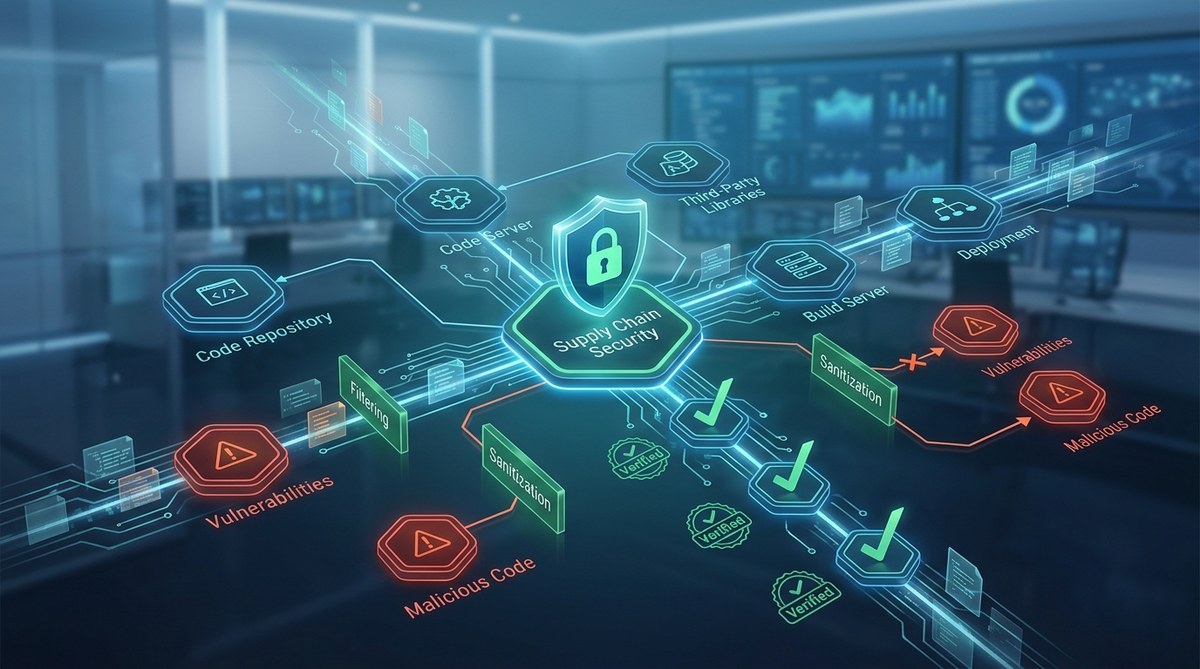
Every time your team pulls in an open-source library, installs a third-party plugin, or trusts a partner API, you are making a bet. You bet that the code is safe, that the maintainers are careful, and that no hidden backdoor is waiting to be triggered. But in 2026, that bet is riskier than ever. The software supply chain has become the single most attractive target for attackers, because one compromised dependency can give them access to hundreds of organizations at once. If you are a DevOps engineer, a cybersecurity professional, or a developer responsible for keeping your organization safe, you already feel the pressure. The good news is that securing your software supply chain is not magic. It is a set of repeatable practices that any team can adopt.
Software supply chain security means continuously verifying every component you build with. Use an SBOM to track dependencies, automate vulnerability scanning, enforce signed commits and strict access controls, and monitor for anomalies. Build a culture where every developer thinks about where code comes from. That simple shift reduces your biggest third-party risk exposure.
Why software supply chain security matters more than ever
The story of the SolarWinds attack taught the industry a painful lesson. One malicious update pushed to thousands of customers. But that was 2020. Since then, the threat landscape has only grown. Attackers now use automated tools to scan public repositories for unpatched libraries. They inject malware into popular packages on npm and PyPI. They compromise CI/CD pipelines and slip malicious code into builds that pass all your existing checks.
In 2026, the average enterprise application pulls in over 500 third-party dependencies. Each one is a potential entry point. The worst part is that you cannot control those external projects. You can only control how you vet, monitor, and update them.
For a deeper look at how modern threats are reshaping risk management, read about why traditional risk management fails in the age of AI and cyber threats.
The real threats lurking in third-party code
It is not just about known vulnerabilities like those in the CVE database. Attackers have become creative. Here are the most common dangers your team should scan for:
- Typosquatting packages — malicious libraries with names that look like popular ones (e.g., “requeests” instead of “requests”).
- Dependency confusion — attackers publish a package with the same name as an internal private package on public registries, tricking your build system into downloading the malicious version.
- Compromised maintainer accounts — legitimate projects taken over by attackers who then push backdoored updates.
- Malicious code in build tools — tampered compilers, linters, or container images that inject malware at build time.
- Unmaintained or abandoned libraries — dependencies that no longer receive security patches but are still widely used.
- Leaked secrets in source code — hardcoded API keys or credentials accidentally pushed to public repos by contributors.
Every one of these scenarios has caused real breaches in the past year alone. Your best defense is visibility and verification.
A practical framework for securing your supply chain
Rather than trying to boil the ocean, follow this structured process. It mirrors the approach many security teams use to build a resilient pipeline.
1. Inventory everything with a software bill of materials (SBOM)
You cannot protect what you do not know. Generate an SBOM for every build. This machine-readable list includes every component, version, license, and dependency relationship. Tools like CycloneDX or SPDX make this straightforward.
Attach the SBOM to your release artifacts. Store them in a central repository. Update them every time a dependency changes.
2. Automate vulnerability scanning across the pipeline
Manual checks are too slow for modern development speeds. Integrate scanners into your CI/CD pipeline at multiple points:
- When a developer opens a pull request
- During the build process
- Before deployment to production
- On a regular schedule for already deployed applications
Use both static analysis (for known CVEs) and dynamic analysis (for behavioral anomalies). Many cloud providers offer built-in scanning, but specialized tools like Snyk, Checkmarx, or Trivy can give you broader coverage.
3. Enforce policy as code
Define rules that your development pipeline must follow before code can move to production. For example:
- No dependencies with critical or high severity vulnerabilities
- All commits must be signed with GPG or SSH keys
- Container images must come from trusted registries only
- Third-party packages must pass a reputation check (age, download count, maintainer history)
Automate these policies in your CI/CD configuration files. That way, a developer cannot accidentally skip a step.
4. Implement continuous monitoring and rapid patching
Security is not a one-time check. Vulnerabilities are discovered every day. Set up alerts for new CVEs affecting your dependencies. Have a process to patch within a defined window (e.g., 48 hours for critical issues).
Consider using a software composition analysis (SCA) tool that monitors production environments and notifies you when a new vulnerability emerges.
For more on building a systematic approach to risk, check out how to build a risk assessment framework that actually works.
Common mistakes and how to fix them
Even experienced teams make these errors. Below is a table of the most frequent pitfalls and their solutions.
| Mistake | Impact | How to fix it |
|---|---|---|
| Only scanning for known CVEs | Misses zero-days, malicious packages, and supply chain attacks. | Add behavioral analysis and dependency reputation checks. Use a tool that detects anomalies. |
| Treating all dependencies equally | Wastes resources on low-risk libraries while ignoring critical public-facing components. | Categorize dependencies by risk level (e.g., network access, privilege escalation potential). Prioritize based on exploitability and business impact. |
| Relying on manual approval for dependency updates | creates bottlenecks that lead to outdated, vulnerable libraries. | Automate minor and patch updates. Use a review process only for major version changes that might break API compatibility. |
| Forgetting to monitor production running code | New CVEs can affect deployed applications even if code is frozen. | Set up continuous monitoring on production containers and serverless functions. Use runtime protection tools. |
| Not signing commits or artifacts | Allows attackers to inject unauthorized code without leaving an obvious trace. | Require signed commits for all team members. Verify artifact signatures in your pipeline. |
Avoiding these mistakes will close the most common gaps in your supply chain security.
Expert advice: What security leaders recommend
I spoke with a CISO at a mid-sized SaaS company that handles sensitive health data. Here is what she told her team:
“Stop treating third-party code like it’s free. Every open-source library you bring in is a relationship. You have to know who maintains it, how often it is updated, and what they do when a vulnerability is reported. If the maintainer disappears, that library becomes a risk. Have a plan to fork or replace it. And never trust a package just because it has a lot of stars on GitHub.”
That advice is especially relevant for regulated industries like healthcare. If you work with medical data, you should also read about 5 critical steps to protect your medical records from data breaches.
How to start securing your supply chain today
You do not need a massive budget or a dedicated security team. Start small with these three actions:
- Generate an SBOM for your main application this week. Use an automated tool built into your package manager or CI system.
- Scan your current dependencies for critical vulnerabilities. Fix any that are exploitable and exposed to external users.
- Adopt a zero-trust mindset for third-party code. Assume every dependency could be compromised until proven otherwise. Verify integrity hashes, pin versions, and review release notes for unusual changes.
As your team matures, add more layers. Consider implementing a vendor risk management program for your commercial software suppliers. Document everything in a risk register. For a template, see how to create a risk register that keeps your team aligned and protected.
Building resilience through continuous vigilance
The attackers are not going to stop targeting third-party components. They love the leverage it gives them. But you can make yourself a hard target. By knowing exactly what is in your software, automating your defenses, and treating every dependency as a potential risk, you build a supply chain that can absorb shocks and recover fast.
Start where you are. Pick one step from this guide and implement it by the end of the week. Then do another. Over time, these habits become second nature. Your code will be safer, your team will be more confident, and your organization will be ready for whatever comes next.