
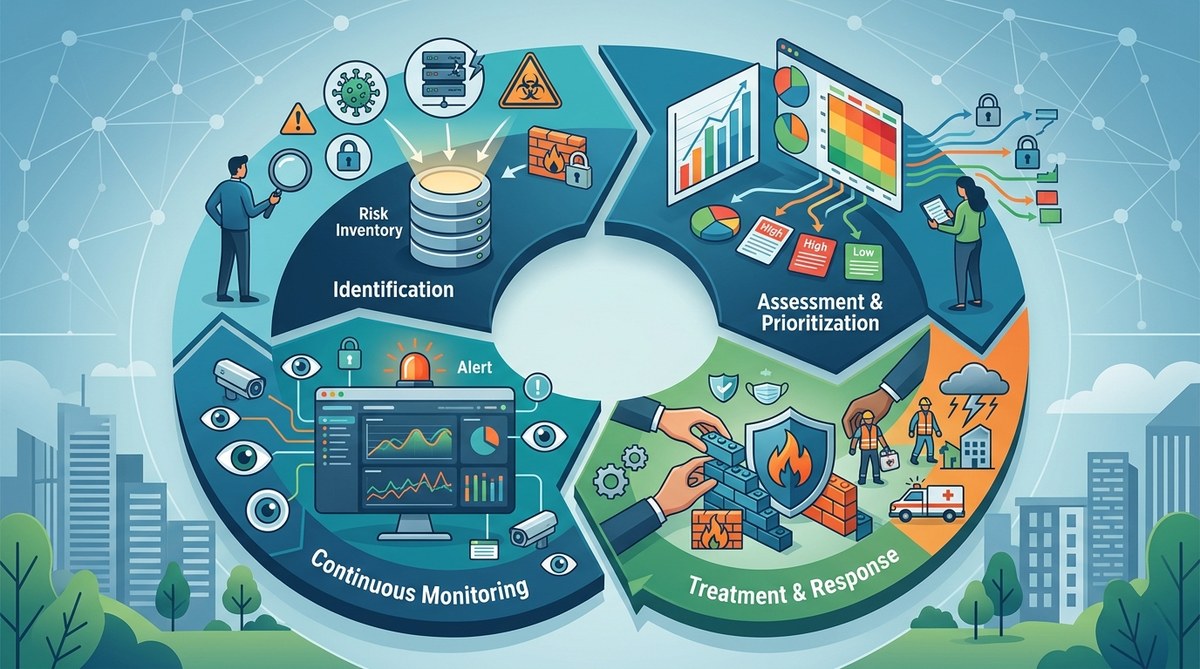
Risk management is not a one-time task. It is an ongoing process that helps your organization stay prepared for uncertainties, whether they stem from cyber threats, health risks, or operational challenges. Knowing how to navigate through each stage of the risk management lifecycle can significantly improve your organization’s resilience and decision-making. This guide breaks down the lifecycle into clear, actionable steps, giving you a practical framework for managing risks from start to finish.
The risk management lifecycle is a continuous, iterative process that involves identifying, assessing, treating, and monitoring risks. Implementing these stages effectively helps organizations stay resilient against threats and adapt to changing circumstances with confidence.
What is the risk management lifecycle?
At its core, the risk management lifecycle is a structured approach to identifying and handling risks systematically. It involves a series of interconnected steps that repeat over time to ensure your organization remains aware of potential threats and can respond proactively. Think of it like a cycle that feeds into itself, constantly refining your risk strategies based on new information and evolving conditions.
This lifecycle isn’t just about avoiding risks but managing them in a way that aligns with your organization’s goals. By understanding each stage deeply, risk managers and compliance officers can build a resilient framework that adapts to the shifting landscape of cyber threats, health emergencies, and operational hazards.
The key stages of the risk management lifecycle
The lifecycle typically consists of five core stages, each playing a vital role in maintaining organizational resilience. These stages are:
- Identification
- Assessment
- Response
- Monitoring
- Review and improvement
Let’s unpack each one to understand how they fit into a cohesive process.
1. Identifying risks
The first step is to pinpoint potential threats that could impact your organization. This involves gathering insights from various sources such as internal audits, employee feedback, industry reports, and technological scans. Think about risks like cyber attacks, supply chain disruptions, health crises, or compliance violations.
Practical methods include conducting risk workshops, leveraging risk registers, and using automated tools for vulnerability scanning. The goal is to create a comprehensive list of risks that could affect your operations so you can address them proactively.
2. Assessing risks
Once risks are identified, the next step is to evaluate their likelihood and potential impact. This helps prioritize which threats need immediate attention. You can use qualitative methods, like expert judgment, or quantitative techniques, such as risk scoring models, to analyze each risk.
A handy way to visualize this process is through a risk matrix that plots likelihood against impact. High-probability, high-impact risks demand urgent actions, while low-probability, minor-impact risks might be monitored over time.
3. Responding to risks
After assessment, the focus shifts to developing strategies to manage the risks. Responses can include:
- Avoidance: Eliminating the risk entirely.
- Mitigation: Implementing controls to reduce the risk’s impact or likelihood.
- Transfer: Shifting risk to a third party, like insurance.
- Acceptance: Acknowledging the risk when mitigation isn’t feasible.
Creating clear response plans ensures your team acts swiftly when a risk materializes. For example, having an incident response plan ready for cyber breaches or health emergencies can save valuable time and resources.
4. Monitoring risks continuously
Risks are dynamic. New threats can emerge, or existing risks can change in severity. Continuous monitoring involves tracking risk indicators, reviewing controls, and staying alert to external developments.
Utilize automated monitoring tools, dashboards, and regular reporting to keep tabs on your risk landscape. The goal is to detect early warning signs so you can adjust your strategies promptly.
5. Reviewing and improving
The final stage is an ongoing review of your risk management practices. This involves analyzing past incidents, assessing the effectiveness of controls, and updating risk assessments based on new data. Feedback loops are critical to refine your process and adapt to changes.
For example, after a health crisis, reviewing response effectiveness can highlight gaps that need addressing. Regularly updating your risk management approach ensures it remains aligned with your organization’s evolving needs.
Practical steps to implement an effective risk management lifecycle
Implementing this lifecycle requires discipline and clarity. Here are three practical steps:
- Develop a risk register that documents identified risks, their assessments, and response plans.
- Leverage technology such as risk management software to automate monitoring and reporting.
- Train your team regularly on risk awareness and response procedures to foster a risk-conscious culture.
Techniques and common mistakes
| Technique | Purpose | Common Mistake |
|---|---|---|
| Risk workshops | Engage stakeholders in identifying risks | Overlooking emerging threats due to narrow focus |
| Risk scoring models | Prioritize risks based on data | Relying solely on qualitative judgment without data support |
| Continuous monitoring tools | Keep risks in check | Ignoring warning signs because of infrequent reviews |
“A key to effective risk management is not just identifying risks but understanding how they can evolve. Regularly revisiting your risk landscape allows your organization to stay ahead of threats.” — Risk expert
The importance of a proactive approach
A reactive stance can leave your organization vulnerable. By systematically working through each stage—especially ongoing monitoring—you gain early insights into risks and can adapt quickly. This agility is vital in a world where cyber threats, health risks, and operational disruptions can change overnight.
Having a clear risk management lifecycle also supports compliance with regulations and standards, which often require documented processes for risk oversight. It builds confidence among stakeholders, demonstrating that your organization is prepared and resilient.
Overcoming challenges in risk management
Managing risks is complex. Common hurdles include limited resources, lack of expertise, and organizational silos. Overcoming these requires:
- Investing in training and technology.
- Promoting a culture of risk awareness.
- Integrating risk management into daily operations rather than treating it as a separate task.
The right tools and mindset can turn risk management from a burden into a strategic advantage.
Building a resilient organization through the lifecycle
Risk management is a journey, not a destination. By adopting a structured lifecycle approach, your organization can become more resilient, agile, and ready to face uncertainties. Remember, the key is consistency and continuous improvement.
Create a risk management plan that fits your organization’s context. Use automated tools to keep watch over evolving risks. Involve your team regularly and foster open communication about threats and responses.
Making risk management a core part of your organization’s DNA
The path to resilience is paved with awareness and action. Incorporate these stages into your routine, and you will find your organization better equipped to handle unexpected challenges. Risk management is not about eliminating all threats but managing them wisely. Start small, learn along the way, and keep refining your approach. The effort will pay off in peace of mind and operational stability.