
Imagine waking up to a video call from your CEO. She asks you to wire $250,000 to a vendor. The voice is perfect. The face is flawless. The mannerisms are spot on. You do it. Later that day, you find out she never made that call. That was a deepfake. And your business just lost a quarter of a million dollars.
Scenarios like this are no longer science fiction. They are happening right now to companies across the United States. The same artificial intelligence that powers your customer chatbots, your fraud detection systems, and your supply chain forecasts is now being weaponized against you. The threat landscape is shifting faster than most risk management frameworks can handle. And if you are a business leader or an IT manager in 2026, understanding these emerging AI threats is no longer optional. It is survival.
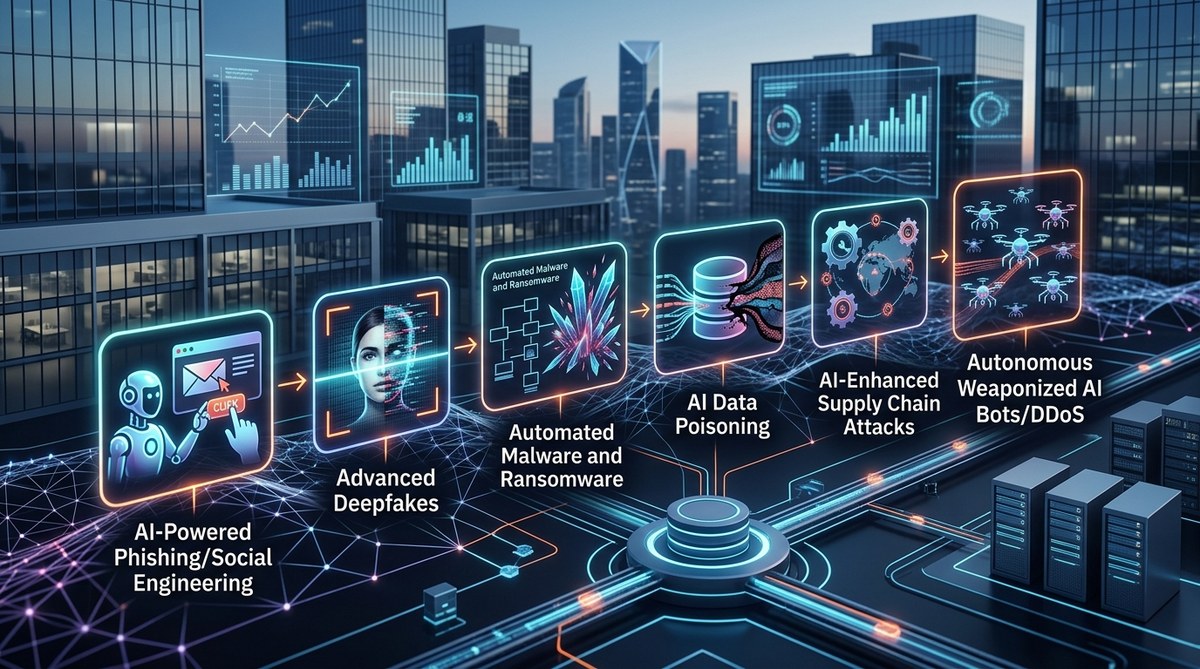
Six emerging AI threats are reshaping business risk in 2026: deepfake impersonation, data poisoning, shadow AI usage, AI-generated adaptive malware, third-party supply chain vulnerabilities, and algorithmic bias. Each one can disrupt operations, drain finances, and damage reputation. The good news? With the right awareness and proactive defenses, you can stay ahead of them.
The New Playbook for Business Disruption
Traditional risk management was built for a slower world. You identified a threat, assessed its likelihood, put controls in place, and moved on. But AI threats are different. They learn. They adapt. They scale at machine speed. A single vulnerability in a large language model can be exploited by attackers on the other side of the world in minutes, not months.
Think about how your business uses AI today. Maybe your team relies on generative AI for drafting contracts or responding to customer inquiries. Perhaps you use machine learning models to predict inventory needs or to flag fraudulent transactions. Each of those tools is a potential entry point. Each one can be turned against you.
Let us walk through the six emerging AI threats that every business leader needs to understand in 2026.
1. Deepfake Social Engineering at Scale
Deepfake technology has crossed a terrifying threshold. It no longer requires a Hollywood studio or a team of data scientists. Free or low-cost tools can generate convincing video, audio, and images of anyone. Your CEO. Your CFO. Your lawyer. Your vendor.
Attackers use deepfakes to impersonate trusted individuals inside your organization. They call an employee in accounting. They send a video message to a manager in HR. They spoof a vendor invoice with a fake voice confirmation. And because the human brain is wired to trust faces and voices we recognize, these attacks work.
The FBI issued a warning in 2025 about a surge in deepfake-enabled business email compromise scams. In 2026, the technology is even harder to detect. If your company has not run a deepfake drill with your finance team, you are already behind.
For a deeper look at how this technology threatens your corporate security, read our guide on 5 ways deepfake technology threatens corporate security and personal privacy.
2. Data Poisoning and Model Manipulation
Your AI models are only as good as the data they are trained on. Attackers know this. They inject corrupted or malicious data into your training sets, slowly shifting your model’s behavior in ways you might not notice for months.
Imagine your fraud detection model starts letting through small fraudulent transactions. Not enough to trigger an alert. Just a few dollars here and there. Over time, the attacker siphons thousands of dollars from your accounts. By the time you catch it, the damage is done.
Data poisoning is especially dangerous because it is a silent attack. Your model still works. It still produces outputs. But those outputs are increasingly unreliable. If you rely on AI for critical decisions like loan approvals, supply chain routing, or medical diagnosis, a poisoned model can cause real harm.
Learn more about how machine learning algorithms can be manipulated by cybercriminals and what you can do to protect your models.
3. Shadow AI and Unsanctioned Tool Usage
Your employees are using AI. Whether you approve it or not. They are pasting customer data into ChatGPT. They are using free AI writing tools to draft internal memos. They are uploading sensitive financial spreadsheets to cloud-based AI platforms to generate summaries.
This is shadow AI. And it is a compliance and security nightmare.
When employees use unsanctioned AI tools, your data leaves your control. It might be stored on servers in jurisdictions with weaker privacy laws. It might be used to train public models. It might be accessed by third parties you never vetted.
In 2026, shadow AI is one of the fastest growing risks for IT managers. The solution is not to ban AI tools completely. That will just drive usage underground. The solution is to provide approved, secure alternatives and to train your team on the risks.
Find out how AI chatbots are leaking sensitive corporate data without anyone noticing and how to prevent it at your organization.
4. AI-Generated Adaptive Malware
Malware used to be static. You could write a signature for it, and antivirus software could detect it. Not anymore. Attackers now use generative AI to write malware that rewrites itself every time it spreads.
This adaptive malware evades traditional detection tools. It changes its code. It alters its behavior. It learns from the defenses it encounters. Each new variant is slightly different from the last, making signature-based detection almost useless.
The cost of entry for creating custom malware has dropped to nearly zero. Anyone with a subscription to a generative AI tool can create a sophisticated virus, worm, or ransomware strain. The barrier to being a cybercriminal has never been lower.
For more on this growing danger, check out our article on the rise of AI-generated malware that adapts to evade detection systems.
5. Third-Party AI Supply Chain Vulnerabilities
Your business probably uses AI components built by other companies. Maybe you use an API from a large language model provider. Maybe you license a computer vision model for your security cameras. Maybe your HR software uses AI to screen resumes.
Every one of those components is a potential vulnerability. If your vendor’s model is compromised, your system is compromised too. You inherit their risk.
In 2025, researchers discovered that several popular open-source AI models contained backdoors inserted by bad actors. Those models were downloaded thousands of times before the backdoors were found. In 2026, the attack surface is even larger.
Your due diligence needs to extend beyond traditional software vendors. You need to assess the security posture of every AI model and API you integrate into your operations.
Read our effective strategies for managing third-party risks in 2026 to build a stronger defense.
6. Algorithmic Bias as an Operational and Legal Risk
AI bias is not just a fairness issue. It is a business continuity issue. A biased model can make decisions that violate regulations, trigger lawsuits, and destroy customer trust.
Consider a hiring algorithm that systematically filters out candidates from certain demographic groups. Or a loan approval model that denies credit to entire neighborhoods. Or a medical triage system that underestimates the severity of symptoms for certain patients.
When these biases cause harm, your business is liable. Regulators are paying attention. Class action lawsuits are already being filed. And the reputational damage can be catastrophic.
Bias often enters models through training data that reflects historical inequalities. But it can also be introduced deliberately by attackers who want to sabotage your operations or tarnish your brand.
Understand how AI bias impacts security systems and what steps you can take to audit your models regularly.
Comparing Traditional and AI-Powered Threats
The table below shows how traditional business threats compare to their AI-powered counterparts. The differences are stark.
| Threat Type | Traditional Version | AI-Powered Version | Key Difference |
|---|---|---|---|
| Phishing | Generic email with typos | Personalized deepfake video or voice message | AI is harder to detect and more convincing |
| Malware | Static code with known signatures | Self-rewriting code that evades detection | AI adapts faster than defenses can update |
| Fraud | Manual manipulation of records | Automated data poisoning of AI models | AI scales across thousands of transactions |
| Social engineering | Phone call from a fake “IT support” | Real-time voice clone of your CEO | AI removes the telltale signs of impersonation |
| Supply chain risk | Compromised hardware or software | Backdoored AI model or poisoned training data | AI vulnerabilities are harder to audit |
| Compliance violation | Deliberate policy breach | Unintended bias in AI decision-making | AI bias can slip past human review |
As you can see, the AI versions are faster, more scalable, and harder to detect. Your defenses need to evolve accordingly.
Three Practical Steps to Defend Against AI Threats
You cannot eliminate every risk. But you can build a resilient defense. Here are three actionable steps you can take starting today.
-
Run regular red team drills that include AI attack scenarios. Simulate a deepfake call to your finance team. Test whether your fraud detection model can spot poisoned data. See how your employees react to a phishing email generated by AI. Practice makes preparation real.
-
Create an approved AI tool list and enforce it. Work with your legal and compliance teams to evaluate AI platforms. Approve the ones that meet your security standards. Block the rest. Then train your employees on why the rules exist and how to use the approved tools safely.
-
Audit your AI models for bias and data integrity. Schedule quarterly reviews of every model you use. Check for drift in outputs. Look for signs of data poisoning. Test for bias across different demographic groups. Document your findings and act on them.
For a more comprehensive approach, read our guide on why traditional risk management fails in the age of AI and cyber threats. It will help you rethink your entire risk framework.
“The biggest mistake business leaders make is treating AI security as an IT problem. It is not. It is a boardroom problem. Every department that touches AI creates risk. Finance, HR, legal, operations. Your risk management strategy needs to be just as cross-functional as your AI deployment.”
* Dr. Elena Vasquez, former CISO of a Fortune 500 technology firm and author of “AI Risk in the Real World”
Building Your AI Threat Awareness Culture
Technology alone will not save you. Your people are your first line of defense. And they need to understand the threats they face.
Start with your leadership team. Make sure every executive knows what deepfakes look like and how they could be used against the company. Then train your managers. Then train every employee who handles sensitive data or financial transactions.
Make it concrete. Show them real examples. Run drills. Celebrate people who spot and report suspicious activity. Build a culture where it is safe to say, “I almost fell for that, but I double checked.”
If you want to go deeper, start with a risk assessment framework that actually works. It will give you a structured way to identify, evaluate, and respond to the specific AI threats facing your business.
Staying Resilient in an AI-Driven World
The six threats we covered are not hypothetical. They are active. They are growing. And they are targeting businesses like yours.
Deepfake impersonation can drain your bank account. Data poisoning can corrupt your decision-making. Shadow AI can expose your confidential data. Adaptive malware can bypass your defenses. Third-party vulnerabilities can open backdoors you never knew existed. And algorithmic bias can land you in court.
But here is the thing. You do not need to be afraid. You need to be prepared.
Start with one step today. Audit the AI tools your team is using. Have a conversation with your CFO about deepfake risks. Run a tabletop exercise with your incident response team. Pick one thing and do it this week.
Every day you wait is a day attackers get smarter. But every step you take makes your business more resilient. You can do this. And we are here to help you stay prepared.“`markdown
Imagine waking up to a video call from your CEO. She asks you to wire $250,000 to a vendor. The voice is perfect. The face is flawless. The mannerisms are spot on. You do it. Later that day, you find out she never made that call. That was a deepfake. And your business just lost a quarter of a million dollars.
Scenarios like this are no longer science fiction. They are happening right now to companies across the United States. The same artificial intelligence that powers your customer chatbots, your fraud detection systems, and your supply chain forecasts is now being weaponized against you. The threat landscape is shifting faster than most risk management frameworks can handle. And if you are a business leader or an IT manager in 2026, understanding these emerging AI threats is no longer optional. It is survival.
Six emerging AI threats are reshaping business risk in 2026: deepfake impersonation, data poisoning, shadow AI usage, AI-generated adaptive malware, third-party supply chain vulnerabilities, and algorithmic bias. Each one can disrupt operations, drain finances, and damage reputation. The good news? With the right awareness and proactive defenses, you can stay ahead of them.
The New Playbook for Business Disruption
Traditional risk management was built for a slower world. You identified a threat, assessed its likelihood, put controls in place, and moved on. But AI threats are different. They learn. They adapt. They scale at machine speed. A single vulnerability in a large language model can be exploited by attackers on the other side of the world in minutes, not months.
Think about how your business uses AI today. Maybe your team relies on generative AI for drafting contracts or responding to customer inquiries. Perhaps you use machine learning models to predict inventory needs or to flag fraudulent transactions. Each of those tools is a potential entry point. Each one can be turned against you.
Let us walk through the six emerging AI threats that every business leader needs to understand in 2026.
1. Deepfake Social Engineering at Scale
Deepfake technology has crossed a terrifying threshold. It no longer requires a Hollywood studio or a team of data scientists. Free or low-cost tools can generate convincing video, audio, and images of anyone. Your CEO. Your CFO. Your lawyer. Your vendor.
Attackers use deepfakes to impersonate trusted individuals inside your organization. They call an employee in accounting. They send a video message to a manager in HR. They spoof a vendor invoice with a fake voice confirmation. And because the human brain is wired to trust faces and voices we recognize, these attacks work.
The FBI issued a warning in 2025 about a surge in deepfake-enabled business email compromise scams. In 2026, the technology is even harder to detect. If your company has not run a deepfake drill with your finance team, you are already behind.
For a deeper look at how this technology threatens your corporate security, read our guide on 5 ways deepfake technology threatens corporate security and personal privacy.
2. Data Poisoning and Model Manipulation
Your AI models are only as good as the data they are trained on. Attackers know this. They inject corrupted or malicious data into your training sets, slowly shifting your model’s behavior in ways you might not notice for months.
Imagine your fraud detection model starts letting through small fraudulent transactions. Not enough to trigger an alert. Just a few dollars here and there. Over time, the attacker siphons thousands of dollars from your accounts. By the time you catch it, the damage is done.
Data poisoning is especially dangerous because it is a silent attack. Your model still works. It still produces outputs. But those outputs are increasingly unreliable. If you rely on AI for critical decisions like loan approvals, supply chain routing, or medical diagnosis, a poisoned model can cause real harm.
Learn more about how machine learning algorithms can be manipulated by cybercriminals and what you can do to protect your models.
3. Shadow AI and Unsanctioned Tool Usage
Your employees are using AI. Whether you approve it or not. They are pasting customer data into ChatGPT. They are using free AI writing tools to draft internal memos. They are uploading sensitive financial spreadsheets to cloud-based AI platforms to generate summaries.
This is shadow AI. And it is a compliance and security nightmare.
When employees use unsanctioned AI tools, your data leaves your control. It might be stored on servers in jurisdictions with weaker privacy laws. It might be used to train public models. It might be accessed by third parties you never vetted.
In 2026, shadow AI is one of the fastest growing risks for IT managers. The solution is not to ban AI tools completely. That will just drive usage underground. The solution is to provide approved, secure alternatives and to train your team on the risks.
Find out how AI chatbots are leaking sensitive corporate data without anyone noticing and how to prevent it at your organization.
4. AI-Generated Adaptive Malware
Malware used to be static. You could write a signature for it, and antivirus software could detect it. Not anymore. Attackers now use generative AI to write malware that rewrites itself every time it spreads.
This adaptive malware evades traditional detection tools. It changes its code. It alters its behavior. It learns from the defenses it encounters. Each new variant is slightly different from the last, making signature-based detection almost useless.
The cost of entry for creating custom malware has dropped to nearly zero. Anyone with a subscription to a generative AI tool can create a sophisticated virus, worm, or ransomware strain. The barrier to being a cybercriminal has never been lower.
For more on this growing danger, check out our article on the rise of AI-generated malware that adapts to evade detection systems.
5. Third-Party AI Supply Chain Vulnerabilities
Your business probably uses AI components built by other companies. Maybe you use an API from a large language model provider. Maybe you license a computer vision model for your security cameras. Maybe your HR software uses AI to screen resumes.
Every one of those components is a potential vulnerability. If your vendor’s model is compromised, your system is compromised too. You inherit their risk.
In 2025, researchers discovered that several popular open-source AI models contained backdoors inserted by bad actors. Those models were downloaded thousands of times before the backdoors were found. In 2026, the attack surface is even larger.
Your due diligence needs to extend beyond traditional software vendors. You need to assess the security posture of every AI model and API you integrate into your operations.
Read our effective strategies for managing third-party risks in 2026 to build a stronger defense.
6. Algorithmic Bias as an Operational and Legal Risk
AI bias is not just a fairness issue. It is a business continuity issue. A biased model can make decisions that violate regulations, trigger lawsuits, and destroy customer trust.
Consider a hiring algorithm that systematically filters out candidates from certain demographic groups. Or a loan approval model that denies credit to entire neighborhoods. Or a medical triage system that underestimates the severity of symptoms for certain patients.
When these biases cause harm, your business is liable. Regulators are paying attention. Class action lawsuits are already being filed. And the reputational damage can be catastrophic.
Bias often enters models through training data that reflects historical inequalities. But it can also be introduced deliberately by attackers who want to sabotage your operations or tarnish your brand.
Understand how AI bias impacts security systems and what steps you can take to audit your models regularly.
Comparing Traditional and AI-Powered Threats
The table below shows how traditional business threats compare to their AI-powered counterparts. The differences are stark.
| Threat Type | Traditional Version | AI-Powered Version | Key Difference |
|---|---|---|---|
| Phishing | Generic email with typos | Personalized deepfake video or voice message | AI is harder to detect and more convincing |
| Malware | Static code with known signatures | Self-rewriting code that evades detection | AI adapts faster than defenses can update |
| Fraud | Manual manipulation of records | Automated data poisoning of AI models | AI scales across thousands of transactions |
| Social engineering | Phone call from a fake “IT support” | Real-time voice clone of your CEO | AI removes the telltale signs of impersonation |
| Supply chain risk | Compromised hardware or software | Backdoored AI model or poisoned training data | AI vulnerabilities are harder to audit |
| Compliance violation | Deliberate policy breach | Unintended bias in AI decision-making | AI bias can slip past human review |
As you can see, the AI versions are faster, more scalable, and harder to detect. Your defenses need to evolve accordingly.
Three Practical Steps to Defend Against AI Threats
You cannot eliminate every risk. But you can build a resilient defense. Here are three actionable steps you can take starting today.
-
Run regular red team drills that include AI attack scenarios. Simulate a deepfake call to your finance team. Test whether your fraud detection model can spot poisoned data. See how your employees react to a phishing email generated by AI. Practice makes preparation real.
-
Create an approved AI tool list and enforce it. Work with your legal and compliance teams to evaluate AI platforms. Approve the ones that meet your security standards. Block the rest. Then train your employees on why the rules exist and how to use the approved tools safely.
-
Audit your AI models for bias and data integrity. Schedule quarterly reviews of every model you use. Check for drift in outputs. Look for signs of data poisoning. Test for bias across different demographic groups. Document your findings and act on them.
For a more comprehensive approach, read our guide on why traditional risk management fails in the age of AI and cyber threats. It will help you rethink your entire risk framework.
“The biggest mistake business leaders make is treating AI security as an IT problem. It is not. It is a boardroom problem. Every department that touches AI creates risk. Finance, HR, legal, operations. Your risk management strategy needs to be just as cross-functional as your AI deployment.”
* Dr. Elena Vasquez, former CISO of a Fortune 500 technology firm and author of “AI Risk in the Real World”
Building Your AI Threat Awareness Culture
Technology alone will not save you. Your people are your first line of defense. And they need to understand the threats they face.
Start with your leadership team. Make sure every executive knows what deepfakes look like and how they could be used against the company. Then train your managers. Then train every employee who handles sensitive data or financial transactions.
Make it concrete. Show them real examples. Run drills. Celebrate people who spot and report suspicious activity. Build a culture where it is safe to say, “I almost fell for that, but I double checked.”
If you want to go deeper, start with a risk assessment framework that actually works. It will give you a structured way to identify, evaluate, and respond to the specific AI threats facing your business.
Staying Resilient in an AI-Driven World
The six threats we covered are not hypothetical. They are active. They are growing. And they are targeting businesses like yours.
Deepfake impersonation can drain your bank account. Data poisoning can corrupt your decision-making. Shadow AI can expose your confidential data. Adaptive malware can bypass your defenses. Third-party vulnerabilities can open backdoors you never knew existed. And algorithmic bias can land you in court.
But here is the thing. You do not need to be afraid. You need to be prepared.
Start with one step today. Audit the AI tools your team is using. Have a conversation with your CFO about deepfake risks. Run a tabletop exercise with your incident response team. Pick one thing and do it this week.
Every day you wait is a day attackers get smarter. But every step you take makes your business more resilient. You can do this. And we are here to help you stay prepared.