
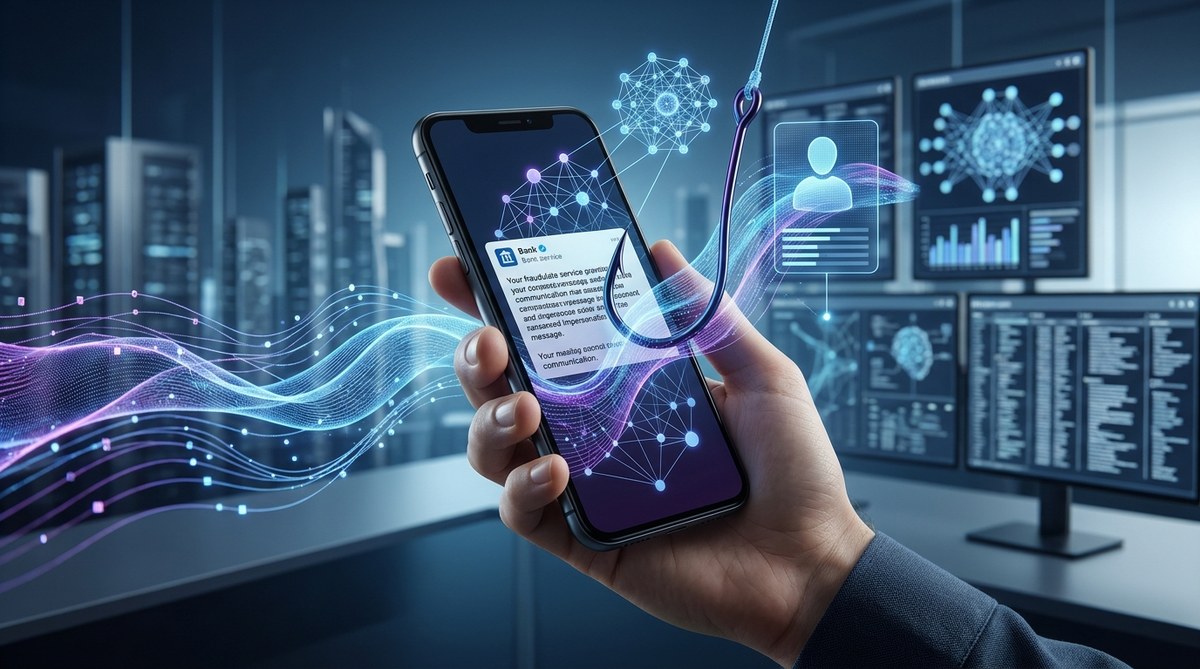
Picture this: You receive an email from your CEO. The tone is urgent but familiar. The grammar is flawless. The request feels perfectly reasonable, right down to the project name you discussed last week. You click the link. Within minutes, your company’s payroll system is compromised, and $250,000 is gone.
That email wasn’t from your CEO. It was written by an AI that studied your CEO’s writing patterns, learned your company’s internal jargon from a leaked Slack archive, and deployed the perfect lie at the perfect moment. This is not a hypothetical scenario. This is the reality of AI-powered phishing attacks in 2026, and they are the most dangerous threat facing organizations today.
AI-powered phishing attacks in 2026 use generative AI to craft personalized, grammatically perfect messages that bypass traditional email filters. Attackers now clone voices, mimic writing styles, and exploit real-time data from social media to build trust instantly. Defending against these threats demands a layered approach combining zero-trust architecture, continuous employee training, and AI-driven detection tools that adapt as fast as the attackers evolve their tactics. This guide explains why these attacks are so dangerous and what you can do about them.
What Makes AI-Powered Phishing Different This Year
Phishing scams have been around since the early days of email. But 2026 marks a turning point. Generative AI has removed the two biggest barriers that used to limit phishing attacks: language quality and personalization.
In 2023, attackers still relied on templates. Their emails contained awkward phrasing, generic greetings, and obvious red flags like “Dear Customer.” Security teams could train employees to spot those clues.
That approach no longer works.
Modern AI models can read through a target’s public social media, past email leaks, and corporate announcements. They can then generate a message that sounds exactly like a trusted colleague. No typos. No strange phrasing. No generic language. Just a perfectly tailored request that arrives at the right moment.
The result? Click-through rates for phishing campaigns have jumped from around 3% in 2020 to estimated rates above 50% in 2026 for AI-assisted attacks. The math is brutal. If a traditional phishing campaign needed to send a million emails to get thirty thousand clicks, an AI-powered campaign can achieve the same result with just sixty thousand emails.
How Attackers Use Generative AI to Build Trust
Trust is the currency of phishing. Attackers know that if they can make you believe the message is real, the battle is half won. Generative AI gives them three powerful tools to build that trust.
Voice cloning and deepfake audio. Attackers now record short samples of a person’s voice from public videos, earnings calls, or social media clips. AI models can then generate new audio of that person saying anything the attacker wants. In 2025, a finance worker in Hong Kong transferred $25 million after receiving a deepfake audio call from what sounded like their CFO. These attacks are becoming cheaper and more accessible every quarter.
Personalized context harvesting. AI can scan a target’s LinkedIn, Twitter, and company website in seconds. It learns names of team members, recent projects, upcoming deadlines, and even personal interests. That knowledge gets woven directly into the phishing message. The email might reference “the Q3 budget review you presented last Tuesday” or “the delayed shipment from your vendor in Ohio.” The level of detail makes the message feel irrefutably real.
Adaptive conversation flows. Some advanced phishing kits now use chatbots that can hold real-time conversations. If the target replies with a question, the AI adjusts its response dynamically. It can answer follow-ups, provide fake documentation, and maintain the disguise across multiple email exchanges. The target never realizes they are talking to a machine.
The Anatomy of a Modern AI Phishing Attack
Understanding how these attacks unfold helps you spot them before it is too late. Here is a step-by-step breakdown of a typical AI-powered phishing campaign in 2026.
-
Target selection and profiling. The attacker chooses a specific person inside an organization, often someone in finance, HR, or IT. They gather public data: email address, job title, reporting structure, recent projects, LinkedIn connections, and any leaked credentials from past breaches.
-
Voice and style mimicry. The attacker feeds a generative AI model samples of the target’s writing style, or the style of someone the target trusts. The AI learns typical sentence lengths, word choices, tone, and even common typos or quirks.
-
Message crafting. The AI generates a phishing message that fits naturally into an existing email thread or conversation. It references real projects, uses correct internal terminology, and matches the sender’s typical communication patterns.
-
Delivery and evasion. The message is sent from a compromised or spoofed account that passes DMARC and SPF checks. AI-powered email filters struggle to flag it because the language is clean and the links point to legitimate-looking domains.
-
Real-time adaptation. If the target responds, the AI continues the conversation. It answers questions, provides fake supporting documents, and maintains the ruse until the target takes the desired action, like approving a payment or sharing credentials.
-
Data exfiltration or fraud execution. Once the target complies, the attacker moves fast. Money gets transferred to mule accounts. Credentials get used to access internal systems. Data gets copied and sold on dark web forums.
Red Flags That Still Work
AI-generated phishing messages are getting harder to spot. But they are not perfect. Here are signs you can still watch for:
- Unusual time stamps. An email from your boss at 2:47 AM on a Saturday? That is worth a second look, even if the tone sounds right.
- Requests that break procedure. The message asks you to bypass normal approval workflows. “Just this once” is a classic phishing trigger, and AI knows how to phrase it convincingly.
- Slight deviations in known relationships. The email might use a nickname the sender never uses, or reference a project in a way that feels slightly off.
- Pressure to act immediately. AI models understand that urgency reduces scrutiny. If the message demands action within minutes, pause and verify through a separate channel.
- Unusual sender behavior. The sender typically never emails you directly. Or they usually send brief messages, and this one is unusually long and detailed.
Common Defense Mistakes Organizations Make
Even experienced security teams fall into traps when facing AI-powered phishing. The table below shows the most common mistakes and what to do instead.
| Common Mistake | Why It Fails in 2026 | Better Approach |
|---|---|---|
| Relying only on email filters | AI-generated text passes standard filters easily because grammar and spelling are clean | Combine filters with behavior-based detection and user reporting |
| Training employees once a year | Phishing tactics evolve faster than annual training cycles can keep up | Run monthly simulated phishing campaigns with AI-generated scenarios |
| Ignoring voice and video threats | Most security programs focus only on email, but deepfake audio calls are rising fast | Extend training to include phone and video verification protocols |
| Trusting sender display names | AI can spoof display names and reply-to addresses convincingly | Enforce email authentication protocols and display full headers |
| Treating all data as low risk | Attackers use seemingly harmless data (LinkedIn updates, blog posts) to personalize attacks | Classify and protect any data that could aid social engineering |
| No verification culture | Employees feel awkward double-checking requests from senior leaders | Create a culture where verification is expected and rewarded |
A Practical Defense Framework for 2026
Defending against AI-powered phishing requires a layered approach. No single tool will save you. But a combination of technology, process, and culture can reduce your risk dramatically.
Start with your technical foundation. Implement DMARC, DKIM, and SPF to make domain spoofing harder. Use AI-powered email security tools that analyze message behavior, not just content. Deploy endpoint detection systems that can flag unusual login locations or device fingerprints.
Then build verification into your processes. Require out-of-band confirmation for any wire transfer, credential reset, or sensitive data request. That means picking up the phone or using a separate messaging app, not replying to the same email thread. Make it a hard rule with no exceptions.
Finally, invest in your people. Run phishing simulations that use AI-generated scenarios, not the obvious “Nigerian prince” templates from十年前. Teach employees how to verify identities using video calls or known phone numbers. Reward those who report suspicious messages instead of punishing those who click.
For a deeper look at building a resilient security program, check out our guide on how to create an incident response plan that actually works.
Why Traditional Security Awareness Falls Short
Most security awareness programs were designed for the phishing threats of 2019. They taught employees to look for misspellings, poor grammar, and generic greetings. Those lessons are now worse than useless. They give employees a false sense of confidence.
An AI-powered phishing email in 2026 will have perfect grammar. It will use your name, your department, and your current project. It might even include a fake attachment that looks exactly like the spreadsheet your team is working on. The old red flags are gone.
What replaces them? Contextual skepticism. Employees need to ask different questions. Does this request make sense given the person’s role and typical behavior? Does it ask me to bypass a normal procedure? Can I verify this through a separate channel? These questions require judgment, not just pattern matching.
We have covered this topic in more detail in our article on why traditional risk management fails in the age of AI and cyber threats. The same principles apply to security awareness.
How to Prepare Your Team for AI Phishing
Building a human firewall takes intentional effort. Here is a practical approach for 2026.
“The best defense against AI-powered phishing is not better technology. It is a culture where verification is automatic and expected. Train your people to pause, verify, and report. Make it easy for them to do the right thing without fear of blame.”
Dr. Patricia Ng, cybersecurity researcher and former CISO
Start with leadership. If the CEO and executive team do not model good security behaviors, no one else will. Have them publicly endorse the verification policy and submit to the same phishing simulations as everyone else.
Run simulations that reflect real threats. Use AI-generated emails that mimic internal communication styles. Include deepfake scenarios where employees receive voice calls that sound like colleagues. The goal is not to trick people. It is to build muscle memory for the moment a real attack lands.
Create clear reporting channels. Employees should know exactly what to do if they suspect a phishing attempt. A single button to report suspicious emails. A dedicated Slack channel for verification requests. A phone number they can call to check whether a request is legitimate.
For organizations just starting this journey, our guide on top strategies to prevent phishing attacks and protect your digital identity offers a solid foundation.
Staying Ahead of the AI Phishing Wave
AI-powered phishing attacks in 2026 are not a future threat. They are here now, targeting organizations of every size and industry. The attackers have access to the same generative AI tools that power productivity apps and creative software. They are using them at scale, and they are getting better every month.
The good news is that you can defend yourself. It takes a combination of smart technology, clear processes, and a culture where security is everyone’s job. The organizations that invest in all three layers will survive the wave. Those that rely on old methods or single solutions will not.
Start today. Review your email security setup. Update your training materials to reflect the AI threat. Talk to your team about the specific risks they might face this year. Every step you take makes your organization that much harder to target.
If you want to explore related risks, take a look at our piece on how to protect your business from deepfake fraud attempts in 2026. The principles there overlap heavily with defending against AI phishing.
The attackers are using AI to get smarter. You need to use AI to get smarter too. But more than that, you need to build a human culture that questions, verifies, and protects. Technology alone will not save you. People who know what to look for and feel empowered to act will.