
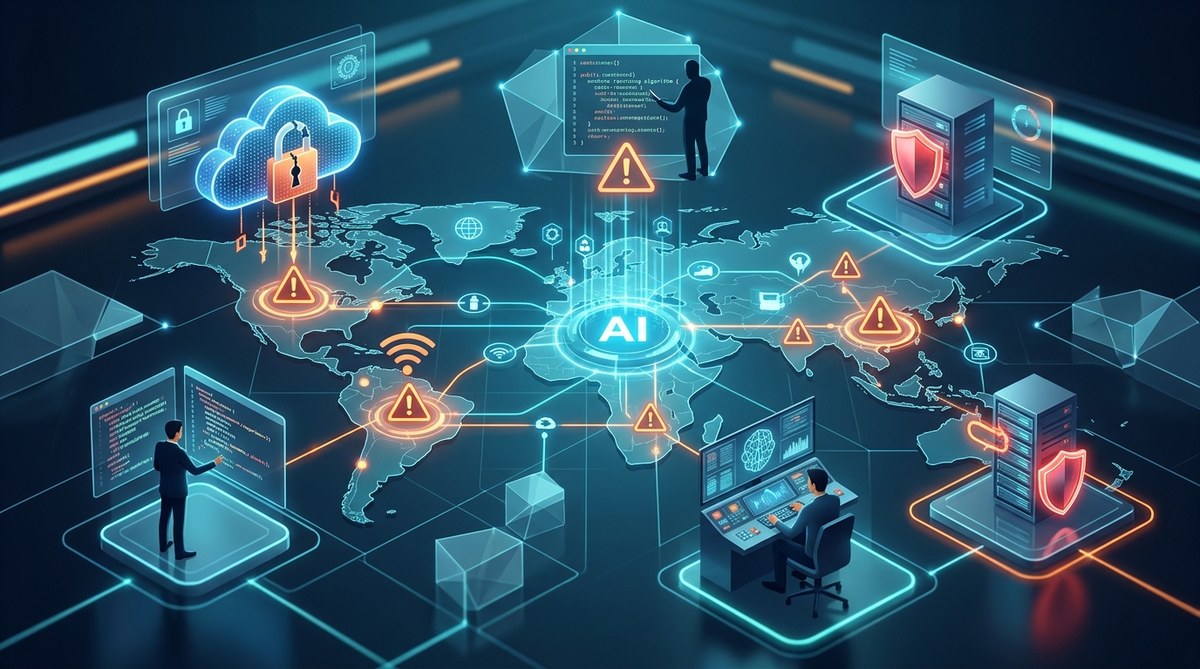
Your supply chain is getting smarter. That is a good thing. AI tools now forecast demand, optimize inventory, select carriers, and even negotiate with suppliers automatically. The efficiency gains are real. But here is the part that keeps security professionals up at night. Every AI model you plug into your supply chain creates a new attack surface you might not even know exists.
Most organizations have spent years securing traditional supply chain risks. You vet vendors. You audit physical security. You encrypt data in transit. But AI introduces a completely different category of threat. These are not theoretical risks. Attackers are actively probing AI models for weak points right now, and your supply chain partners might be the easiest way in.
AI is reshaping supply chain management, but it’s also creating critical security blind spots that most organizations haven’t yet addressed. From poisoned training data and adversarial model attacks to weak AI-to-AI authentication and missing incident response plans, these gaps leave businesses dangerously exposed. This practical guide breaks down six of the most dangerous AI supply chain security gaps facing companies today and gives you actionable steps to close them before attackers exploit your critical vulnerabilities.
The Visibility Problem Nobody Talks About
Here is the uncomfortable truth. Your supply chain probably runs on AI models that you did not build and cannot fully inspect. When your logistics platform uses a machine learning model to predict shipping delays, that model might have been trained on data from a hundred different companies. Some of that data could be poisoned. When your procurement system uses an AI chatbot to communicate with suppliers, that chatbot might be vulnerable to prompt injection attacks that leak your pricing strategies.
The core issue is visibility. Traditional supply chain security lets you audit your vendors. You can ask for SOC 2 reports, run penetration tests, and review access controls. But how do you audit a machine learning model? How do you verify that the training data for your demand forecasting AI has not been tampered with? Most organizations cannot answer those questions, and that is exactly the problem.
Let us walk through the six critical security gaps that demand your attention right now.
Gap 1: Blind Spots in Third-Party AI Components
Your vendors use AI. Their vendors use AI. And those vendors probably use AI too. By the time you reach the end of that chain, you have no idea what data your models were trained on or how they behave under stress.
This is not just a software supply chain issue. It is an AI supply chain issue. When you subscribe to a SaaS platform that uses machine learning to optimize your inventory, you are trusting that platform’s entire AI development pipeline. If they trained their model on data from a breached source, your inventory decisions could be compromised. If they used open source components with known vulnerabilities, those vulnerabilities become your problem.
A real world example from 2025 illustrates the risk. A major logistics provider discovered that one of their AI routing models had been subtly manipulated through a compromised training dataset. The model consistently routed shipments through a specific warehouse, even when alternative routes were faster. The manipulation went undetected for months because nobody was monitoring the model’s behavior against expected patterns.
The challenge here is that traditional vendor risk assessments do not cover AI. You need a new framework. Understanding how to build a risk assessment framework that actually works is the first step toward identifying these blind spots before they become breaches.
Gap 2: Data Poisoning in Shared Training Pipelines
AI models learn from data. If that data is corrupted, the model makes bad decisions. Data poisoning is not a new concept, but the scale of the risk in supply chain AI is staggering.
Consider what happens when your demand forecasting model is trained on historical sales data. If an attacker can inject fake sales records into that training pipeline, the model will learn incorrect patterns. It might understock a profitable product or overstock a slow mover. The result is lost revenue and wasted inventory. But it gets worse. Sophisticated attackers can poison data in ways that are almost impossible to detect. They insert subtle biases that only activate under specific conditions, like a competitor launching a new product or a geopolitical event disrupting shipping lanes.
The most dangerous part is that many organizations share training data across their supply chain ecosystem. Your logistics provider trains their models on data from all their customers. If one customer’s data is compromised, every other customer inherits that compromise.
Protecting against data poisoning requires strict controls over your training pipelines. You need to validate every data source, monitor for statistical anomalies, and maintain a clear lineage of where your training data comes from. This is a risk management mistake that could cost your business everything if you ignore it.
Gap 3: Adversarial Attacks on Real Time Decision Models
Data poisoning attacks the training phase. Adversarial attacks target the model while it is running. These attacks craft specific inputs that cause the model to make wrong predictions.
Think about what that means in a supply chain context. Your AI powered inventory system uses a model to predict demand for the next quarter. An attacker sends a carefully crafted set of signals, maybe fake social media trends or manipulated market data, that cause the model to predict a massive demand spike for a product you barely sell. You rush to order inventory. You pay premium shipping rates. You tie up warehouse space. And then nothing happens. The demand never materializes. You are left holding excess stock and the attacker just cost you real money.
Adversarial attacks can also target quality control systems. AI vision models that inspect products on assembly lines can be fooled by subtle modifications that humans would never notice. A defective product passes inspection. A good product gets rejected. Both outcomes damage your operations.
The traditional approach to risk management was never designed to handle these kinds of threats. That is why many security teams are recognizing that traditional risk management fails in the age of AI and cyber threats. You need monitoring systems that look for adversarial inputs specifically, not just generic anomalies.
Gap 4: Model Theft and Intellectual Property Loss
Your supply chain AI models are valuable intellectual property. They encode years of operational data, pricing strategies, supplier relationships, and customer behavior patterns. Losing those models to a competitor or a nation state actor is a disaster.
Model theft often happens through public APIs. If your demand forecasting model is accessible through an API, an attacker can query it thousands of times and reconstruct a close approximation of the model. This is called model extraction. It does not require breaking into your network. It just requires patience and a little bit of budget.
Edge deployments create even more risk. Many supply chain operations run AI models on edge devices, like cameras in warehouses or sensors on shipping containers. These devices are often physically accessible. If an attacker can steal the device or extract the model from its memory, they walk away with your proprietary algorithms.
The solution is not to stop using AI. It is to protect your models the same way you protect your other intellectual property. Encrypt models at rest and in transit. Rate limit API access. Monitor for unusual query patterns. And treat your AI models as critical assets in your risk register. If you need help structuring that, learning how to create a risk register that keeps your team aligned and protected is a solid starting point.
Gap 5: Missing AI Specific Incident Response Plans
Here is a question for you. If your demand forecasting model starts making wildly inaccurate predictions tomorrow, what do you do? Who do you call? How do you roll back to a previous version? How do you determine whether the problem is a data issue, a model issue, or an active attack?
Most organizations do not have answers to those questions because their incident response plans were written before AI was a factor. A typical incident response plan covers data breaches, ransomware, and network intrusions. It does not cover model degradation, data poisoning, or adversarial inputs.
This gap is dangerous because AI failures can cascade quickly. A compromised inventory model affects procurement, which affects manufacturing, which affects shipping, which affects customer satisfaction. By the time you trace the problem back to the AI model, the damage is already done.
You need incident response plans that specifically address AI related failures. These plans should include procedures for model validation, rollback mechanisms, communication protocols with vendors who provide AI services, and forensic analysis of model behavior. Building these capabilities takes time, which is why creating an incident response plan that actually works should be a priority before you face an actual incident.
Gap 6: Weak Authentication in AI to AI Handoffs
This is the gap that keeps getting overlooked because it sounds futuristic. But it is happening right now. Your AI systems talk to each other without human supervision. Your inventory AI tells your procurement AI to order more raw materials. Your logistics AI tells your warehouse AI to reserve space for incoming shipments. These handoffs happen through APIs, and those APIs often have weak authentication.
The problem is that AI to AI communication creates new trust relationships that traditional security models never anticipated. Two systems might authenticate to each other using static API keys that never rotate. Or they might trust each other based on network location rather than identity. Or they might skip authentication entirely because the developers assumed the internal network was safe.
Attackers exploit these assumptions. If they compromise one AI system in your supply chain, they can use its trusted relationship with other systems to move laterally. Your warehouse AI trusts your inventory AI. If the inventory AI is compromised, the attacker can send fake inventory data to the warehouse and cause chaos.
This is where zero trust principles become essential. Every AI to AI interaction should be authenticated, authorized, and logged. No system should automatically trust another system just because they are on the same network. Understanding what zero trust security is and why your organization needs it now will help you design authentication policies that protect these automated handoffs.
Common Gaps and How to Address Them
Here is a table that summarizes the gaps we covered and the actions you can take to close each one.
| Security Gap | What It Looks Like in Practice | Action to Close It |
|---|---|---|
| Third party AI blind spots | Vendor models trained on unverified data | Require AI transparency reports from vendors |
| Data poisoning | Attacker injects fake training data | Validate and lineage track all training data |
| Adversarial attacks | Malicious inputs trick live models | Deploy adversarial input detection systems |
| Model theft | Model extraction via public APIs | Rate limit APIs and encrypt edge models |
| Missing AI incident plans | No procedure for model failures | Add AI specific scenarios to your IR plan |
| Weak AI to AI auth | Systems trust each other by default | Implement zero trust for all internal APIs |
A Practical Process for Closing the Gaps
Theory is useful. Action is better. Here is a numbered process you can start using this week to address the AI supply chain security gaps in your organization.
-
Map your AI dependencies. Identify every AI model and AI powered service in your supply chain. Include models you built, models you bought, and models your vendors use. You cannot secure what you do not know exists.
-
Assess each model’s risk profile. Score each model based on the sensitivity of the data it processes, the criticality of its decisions, and its exposure to external inputs. High risk models get prioritized attention.
-
Demand transparency from vendors. Ask your vendors for an AI transparency report. What data was their model trained on? What security testing have they done? How do they handle model updates? If they cannot answer, that is a red flag.
-
Monitor model behavior continuously. Set up monitoring that tracks model predictions against expected ranges. Sudden deviations could indicate an attack. Treat model monitoring the same way you treat network monitoring.
-
Test for adversarial vulnerabilities. Run adversarial testing against your highest risk models. See how they respond to manipulated inputs. You might be surprised at how easily they can be fooled.
-
Update your incident response plan. Add specific procedures for AI related incidents. Include rollback procedures, vendor contact information, and forensic analysis steps.
This process is not a one time exercise. It should become part of your regular risk management cycle. As your supply chain adopts new AI capabilities, your security approach needs to evolve alongside it.
Where Your Traditional Risk Management Falls Short
Many cybersecurity and supply chain professionals are discovering that the tools and frameworks they have relied on for years do not work well for AI threats.
Here are the most common problems:
- Your vendor risk questionnaires do not ask about AI training data or model security
- Your penetration tests focus on network and application layers, not on model behavior
- Your incident response drills simulate ransomware but not data poisoning
- Your access controls treat AI systems as regular applications rather than as unique risk surfaces
- Your monitoring tools flag unusual network traffic but not unusual model predictions
These gaps exist because AI security is still new. The frameworks are still being built. But waiting for perfect solutions is not an option. Attackers are already targeting AI models. You need to adapt your risk management approach now.
“The biggest mistake I see organizations make is treating AI models as black boxes that they trust implicitly. You would never deploy a new application without security testing. But companies deploy AI models into their supply chains every day without asking basic security questions. That has to change.” – Senior Supply Chain Security Consultant, 2026 Industry Report
Staying Ahead of the Next Wave of Supply Chain Threats
The six gaps we covered are not going away. They will evolve as AI becomes more deeply embedded in supply chain operations. New gaps will emerge as attackers discover new techniques. The goal is not to achieve perfect security. That is not realistic. The goal is to build enough visibility and response capability that you can catch problems before they become disasters.
Start with the gaps that pose the highest risk to your specific operations. For some organizations, that means focusing on third party AI dependencies first. For others, it means strengthening AI to AI authentication. There is no single right answer. The right answer is the one that addresses your biggest exposure.
One thing is certain. The organizations that treat AI security as a core part of their supply chain risk management will be the ones that thrive. The ones that ignore it will learn the hard way.
Take stock of your AI supply chain security gaps today. Map your models. Talk to your vendors. Update your plans. The work is not glamorous, but it is the work that keeps your business running when the next attack comes.