
Your phone lights up with a message that looks exactly like it came from your bank. The logo is right. The tone is right. It references a transaction that happened yesterday. And somehow, your first name is in the greeting. You never signed up for this kind of alert. But the sender seems to know you.
- Your email can travel from a sign-up form to a scammer’s database in just a few data handoffs.
- Loyalty programmes and free apps are among the most common starting points for this exposure.
- Third-party data sharing, data breaches, and resale are the three main transfer stages.
- Using a dummy email for untrusted sites stops the problem before it reaches your real inbox.
- Acting before your primary address spreads widely is far easier than cleaning up after a breach.
That Moment When the Scam Texts Feel Too Targeted to Be Random
For many Singapore residents, oddly personalised messages have become a familiar nuisance. A WhatsApp notification claims to be from your delivery platform. An email warns you about a subscription you vaguely remember signing up for. A call arrives using your name and references a service you actually use.
None of this is random. These messages are built from data. And that data has a very specific starting point: the last time you tapped “Sign Up” without reading a single line of the terms.
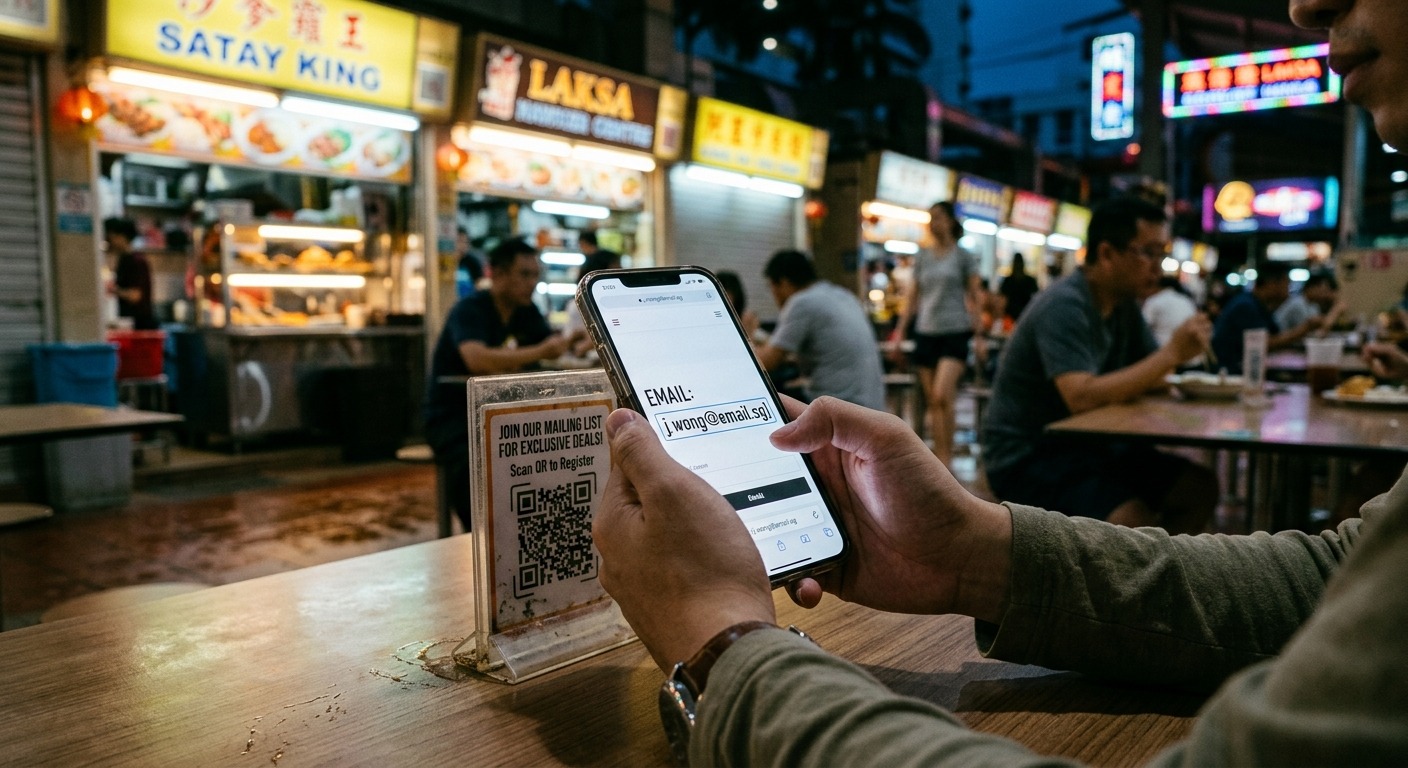
It is rarely a dramatic breach that starts this chain. It is an ordinary sign-up for a hawker delivery app, a free trial, a shopping rewards card. You fill in your name and email, agree to terms and conditions you did not read, and move on. That single action sets off a process that can take weeks or months to reach a scammer’s list, but it very often does.
The Terms and Conditions Nobody Reads
Buried inside the privacy policy or service agreement of most consumer apps is a clause about sharing your data with “affiliated partners,” “marketing collaborators,” or “third-party service providers.” This practice is common. It is also generally permitted under Singapore law, as long as the company discloses it in their documentation.
The disclosure is real. The problem is that almost nobody reads it. Even if you did, “affiliated partners” is vague enough to cover a very wide network. That single sign-up potentially authorises your data to flow to several downstream companies, each of which may have their own sharing arrangements.
Singapore’s data protection obligations require companies to act responsibly with personal data and to notify individuals when serious breaches occur. However, by the time a breach is confirmed and officially reported, your email address has often already circulated through multiple hands. The legal framework protects rights in principle, but the pace of data movement in practice outpaces enforcement.
How Your Email Moves From a Loyalty App to a Phishing List
The lifecycle of a leaked email address follows a fairly predictable path. You register for a rewards programme. The app’s terms allow them to pass your contact details to commercial partners. One of those partners is a data broker: a business built entirely around aggregating, packaging, and reselling consumer profiles at scale.
The broker combines your email with additional data points: location signals, device identifiers, browsing behaviour, purchase history. The resulting profile is sold to advertisers and marketers. Some of those buyers operate within the law. Others do not, and they resell or leak the data further down the chain.
Eventually, a copy ends up in a credential dump on a hacker forum. A phishing operator buys the list. They segment it by country, filter for active addresses, and launch a campaign. Your email is now in the hands of someone who has never met you and does not need to. They already have enough context to impersonate your bank, your telco, or a government agency with unsettling accuracy.
Data breaches accelerate this entire process. When any service you registered with suffers a breach, your email moves from a commercially traded asset into a completely uncontrolled environment. Breaches affecting Singapore residents are more frequent than most people realise. The trail from sign-up to exposed inbox can be surprisingly short.
Why These Phishing Messages Feel So Uncomfortably Specific
Modern phishing campaigns do not blast out generic “Dear Customer” messages and hope for the best. The operators behind them buy enriched profiles, not just email lists. Your name, phone number, general location, and the platforms you are known to use can all be assembled from multiple purchased sources.
The result is a message that greets you by name, references the right bank, and arrives near the time of month when your bill is due. That specificity creates a moment of genuine doubt. You pause before deleting it. That pause is exactly what the attacker is counting on.
In Singapore, scam losses run into hundreds of millions annually. Local scam reports consistently show that phishing ranks among the top tactics used against residents, and the targeting precision of these campaigns has improved steadily as personal data becomes cheaper and easier to acquire.
Your First Line of Defence Before You Ever Click Register
The most effective protection happens before your real email address reaches an untrusted sign-up form. The logic is straightforward. If your primary inbox never appears on an unvetted registration, it cannot enter the data broker pipeline from that source.
This is exactly where a dummy email earns its place as the lowest-friction protective habit you can build. A dummy address is a disposable or purpose-specific email that you use for registrations you are uncertain about: free trials, promotional sign-ups, loyalty apps, and any site offering a one-time discount in exchange for your contact details.
Your primary email carries significant identity weight. It is tied to your bank, your employer, your SingPass, and your most trusted accounts. Every unnecessary appearance of that address on an unverified form increases the probability that it eventually reaches someone who should not have it.
A dummy account absorbs that risk instead. If it fills up with spam, you discard it and create another. Your real inbox stays protected, and the identity signals attached to it stay out of the wrong hands. This is not a technical fix requiring special tools. A free secondary Gmail or Outlook account takes minutes to create and can be put to use immediately.
Choosing the Right Email Address for Each Type of Site
| Service Type | Risk Level | Email to Use | Reason |
|---|---|---|---|
| Government portals (SingPass, CPF, IRAS) | Low | Primary email | Identity-verified and subject to strict regulatory oversight |
| Banks and major insurers | Low to Medium | Primary email | Regulated entities, but breach exposure still possible; monitor alerts |
| E-commerce and delivery platforms | Medium | Secondary email | Heavy marketing partner sharing; frequently targeted in breaches |
| Loyalty programmes and reward apps | Medium to High | Secondary or dummy email | Third-party data sharing is built into the core business model |
| Free apps, browser games, and trial offers | High | Dummy email | User data is frequently the primary product being monetised |
| Unknown or newly registered sites | Very High | Dummy email only | No accountability, track record, or regulatory standing to rely on |
Additional Habits That Strengthen Your Email Posture
The dummy email strategy handles the intake problem. You also need to manage the accounts you have already created over the years. A password manager is worth using not just for credentials, but as a registration audit log. It gives you a complete record of every service you have signed up with. That record is invaluable when you want to delete old, dormant accounts that are still sitting in someone’s database with your real email attached.
Two-factor authentication on your primary email account is non-negotiable at this point. If a scammer acquires your email address and a leaked password from a breach, 2FA becomes the barrier that prevents them from accessing your account and resetting every other login connected to it. Enable it once and it works quietly in the background from that point on.
Mobile app permissions are also worth reviewing periodically. Many apps request access to your contacts during installation. That means your email address and the addresses of everyone you know can be harvested without any separate action on their part. Tightening these permissions closes a gap that most people never notice is open.
What to Do If Your Primary Address Is Already Out There
If you have been using the same email for everything over many years, the exposure has likely already happened. That is not a reason to give up. The goal now is to limit how much further it spreads and to reduce the damage from what is already in circulation.
Start by checking your address against a reputable breach notification service. These tools cross-reference your email against known data dumps and show you which platforms have been compromised and when. Once you know where the leaks originated, you can prioritise closing accounts, changing passwords, and enabling stronger authentication on the services that matter most.
If you are already receiving phishing attempts, set up inbox filters that move suspicious senders into a separate folder. This reduces the daily cognitive load without hiding the problem entirely. You can review the folder on your own terms rather than being interrupted by each attempt as it arrives.
For particularly convincing or aggressive phishing messages, file a report. The ScamAlert portal maintained by Singapore authorities accepts scam submissions, and the pattern data contributes to broader efforts to identify and disrupt active campaigns targeting local residents. It takes two minutes and costs nothing.
The Habit That Costs Nothing and Pays Off Immediately
The uncomfortable truth about email-based scams is that the entry point is rarely dramatic. Not a suspicious attachment you were tricked into clicking. Not a sophisticated targeted attack on your accounts. Just a sign-up form on a loyalty app that offered a free welcome voucher.
That routine action, repeated across dozens of platforms over months and years, builds a data footprint that fraudsters actively seek out and purchase. The pipeline that carries your email from a rewards card registration to a phishing campaign is well-established, efficiently run, and entirely invisible to the person whose data is moving through it.
Changing the outcome does not require becoming a security professional. It requires a small shift in how you think about sign-up forms. Treat your primary email address with the same selectivity you would apply to your home address. Give it to services that have genuinely earned your trust. Use a disposable address for everything else. Go back and delete old accounts you no longer use. These are not dramatic changes.
But applied consistently, they cut the pipeline at its source, before your email ever reaches the hands that would use it against you.